
AODD Pump Materials Explained: Aluminium, Stainless Steel, Polypropylene & PVDF
This AODD pump materials guide explains the difference between aluminium, stainless steel, polypropylene and PVDF air operated double diaphragm pumps. Choosing the right pump body material is an important part of pump selection because the wetted parts must be suitable for the fluid, site conditions and long-term duty.
An AODD pump may be able to handle a wide range of fluids, but the material choice still needs to be correct. The wrong pump body, diaphragm, ball, seat or seal material can lead to corrosion, swelling, cracking, leakage, contamination or premature pump failure.
This guide explains the common strengths and limitations of aluminium, stainless steel, polypropylene and PVDF AODD pumps, and how to approach material selection before choosing a final pump.
Why AODD Pump Material Selection Matters
Material selection affects how well a pump performs, how long it lasts and whether it is suitable for the fluid being transferred. It is especially important when handling chemicals, cleaning fluids, food products, solvents, wastewater or abrasive liquids.
When selecting AODD pump materials, consider:
- The fluid being pumped
- Chemical concentration
- Operating temperature
- Solids content or abrasion
- Viscosity
- Hygiene or contamination risk
- Indoor or outdoor installation
- Washdown exposure
- Hazardous area classification
- Diaphragm, ball, seat and seal compatibility
The pump body material is only part of the decision. A pump may have a compatible body material but unsuitable diaphragms, valve balls, seats or O-rings. A complete selection should consider the full wetted path.
Metallic vs Non-Metallic AODD Pumps
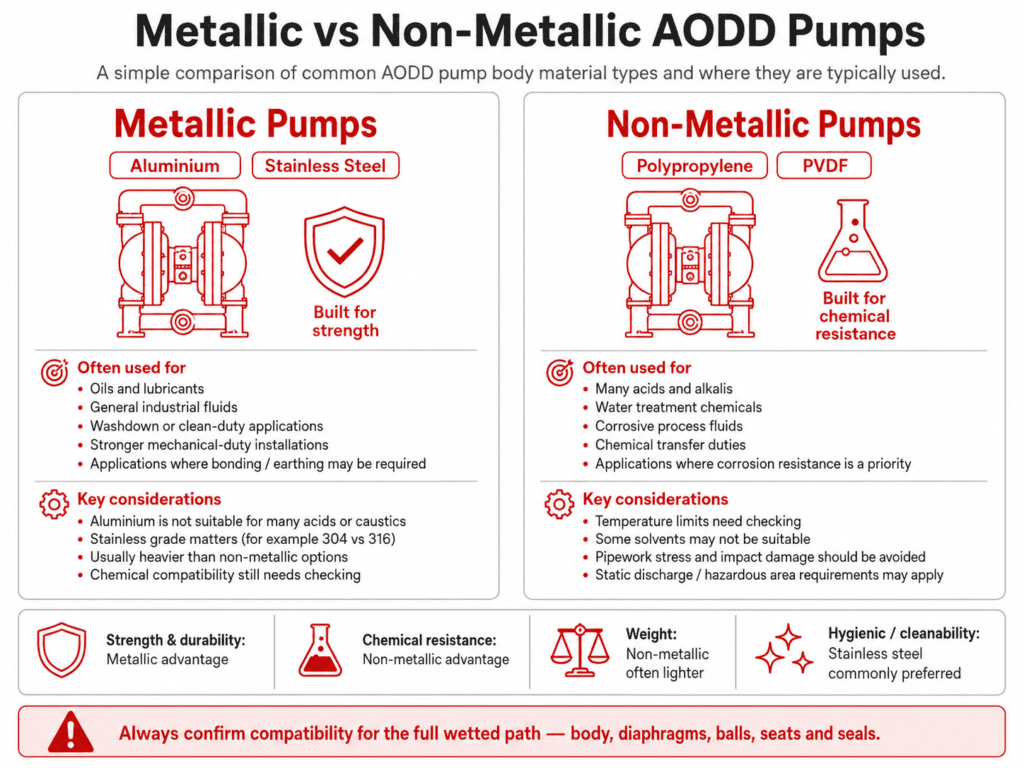
AODD pump body materials are usually split into two broad groups: metallic and non-metallic.
Metallic pumps are commonly chosen where strength, durability, conductivity or impact resistance is important. Aluminium and stainless steel are the most common metallic body materials.
Non-metallic pumps are commonly chosen where chemical resistance is the main requirement. Polypropylene and PVDF are widely used for acids, alkalis and other corrosive fluids, depending on compatibility.
Neither option is automatically better. The correct choice depends on the fluid, temperature, environment and installation requirements.
Metallic AODD Pumps
Metallic AODD pumps are often used for:
- Oils and lubricants
- General industrial fluids
- Solvents, where compatible
- Higher-duty installations
- Applications requiring mechanical strength
- Installations where bonding and earthing may be required
Metallic pumps can offer strong durability, but they are not suitable for every chemical. Aluminium in particular should not be assumed suitable for acids, caustics or corrosive fluids.
Non-Metallic AODD Pumps
Non-metallic AODD pumps are often used for:
- Chemical transfer
- Water treatment chemicals
- Acids and alkalis, where compatible
- Corrosive washdown fluids
- Process chemicals
- Applications where metal contact is unsuitable
Non-metallic pumps can provide strong chemical resistance, but temperature, impact resistance, pipework stress and static discharge must still be considered.
Aluminium AODD Pumps
Aluminium is a common AODD pump material for general industrial transfer duties. It is lightweight, practical and usually more cost-effective than stainless steel or PVDF.
Aluminium pumps are often selected where the fluid is not aggressive and the application does not require high chemical resistance or hygienic construction.
Typical Uses for Aluminium Pumps
Aluminium AODD pumps are commonly used for:
- Oils
- Lubricants
- Waste oils
- Coolants
- Diesel or fuel transfer, where compatible
- Some solvents
- General non-corrosive industrial fluids
They are often found in workshops, maintenance areas, manufacturing sites and general transfer applications.
Advantages of Aluminium
Aluminium offers several practical advantages:
- Lightweight body construction
- Lower cost compared with stainless steel or PVDF
- Good availability across many pump sizes
- Suitable for many general industrial fluids
- Easy to handle and install
- Useful for mobile or workshop transfer duties
For simple, non-corrosive fluid transfer, aluminium can be a sensible and economical choice.
Limitations of Aluminium
The main limitation of aluminium is chemical compatibility. It can be unsuitable for many acids, caustics and aggressive chemicals. It is also not usually the preferred option for hygienic or high-purity applications.
Aluminium may not be suitable for:
- Strong acids
- Strong alkalis
- Corrosive chemicals
- Food-grade applications
- High-purity fluids
- Fluids where aluminium compatibility is uncertain
Choose aluminium when the fluid is non-corrosive, the duty is general industrial transfer and cost-effectiveness is important.
Stainless Steel AODD Pumps
Stainless steel AODD pumps are used where durability, corrosion resistance and cleanability are important. They are commonly selected for food, pharmaceutical, chemical and demanding industrial applications.
Stainless steel pumps are usually more expensive than aluminium, but they offer a stronger and more corrosion-resistant body material.
Typical Uses for Stainless Steel Pumps
Stainless steel AODD pumps are commonly used for:
- Food and beverage products
- Pharmaceutical and cosmetic fluids
- Clean process liquids
- Solvents, where compatible
- Washdown environments
- Chemical transfer, where compatible
- High-duty industrial transfer
- Applications requiring improved corrosion resistance
Advantages of Stainless Steel
Stainless steel offers several important advantages:
- Strong and durable construction
- Good corrosion resistance
- Suitable for clean and washdown environments
- Better impact resistance than many plastic materials
- Available in hygienic pump designs
- Suitable for many demanding process applications
In many applications, stainless steel provides a good balance between strength, cleanliness and corrosion resistance.
304 vs 316 Stainless Steel
The grade of stainless steel matters. 304 stainless steel is commonly used for general clean-duty applications, while 316 stainless steel provides improved corrosion resistance in more demanding environments.
For applications involving chlorides, cleaning chemicals, food production or chemical exposure, the grade of stainless steel should be confirmed before selecting the final pump.
Limitations of Stainless Steel
Stainless steel is versatile, but it is not universally chemical resistant. Certain acids, chlorides and aggressive cleaning fluids can still cause compatibility issues.
Stainless steel pumps can also be heavier and more expensive than aluminium or polypropylene pumps.
Choose stainless steel when the application needs strength, durability, corrosion resistance, washdown suitability or hygienic construction.
Polypropylene AODD Pumps
Polypropylene is one of the most common non-metallic AODD pump materials. It is widely used for chemical transfer because it offers good resistance to many acids, alkalis and water-based chemicals.
Polypropylene is often a practical choice when aluminium is not chemically suitable and PVDF or stainless steel would be more than the application requires.
Typical Uses for Polypropylene Pumps
Polypropylene AODD pumps are commonly used for:
- Water treatment chemicals
- Acids, where compatible
- Alkalis, where compatible
- Cleaning chemicals
- Chemical dosing and transfer
- Surface treatment fluids
- Wastewater chemicals
- General corrosive fluid transfer
Advantages of Polypropylene
Polypropylene offers several useful benefits:
- Good chemical resistance for many common chemicals
- Lower cost than PVDF
- Lightweight construction
- Suitable for many water-based corrosive fluids
- Broad availability across common AODD pump sizes
- Practical option for many chemical transfer duties
For many chemical applications, polypropylene is the first non-metallic body material to consider.
Limitations of Polypropylene
Polypropylene has limits. It may not be suitable for certain solvents, hydrocarbons, oxidising chemicals or higher-temperature duties. It can also be less mechanically robust than metallic pump bodies.
Extra care may be needed where there is:
- High fluid temperature
- Solvent exposure
- Outdoor UV exposure
- Risk of impact damage
- Pipework stress
- Hazardous area classification
- Static discharge risk
Pipework should be properly supported so that the pump body is not carrying unnecessary load from the installation.
Choose polypropylene when chemical resistance is needed for a compatible fluid and the application does not require stainless steel or PVDF.
PVDF AODD Pumps
PVDF is a high-performance non-metallic pump material used for demanding chemical transfer applications. It is often selected where polypropylene is not suitable and stronger chemical resistance is required.
PVDF pumps are usually more expensive than polypropylene, but they can be the correct choice for aggressive chemical duties.
Typical Uses for PVDF Pumps
PVDF AODD pumps are commonly used for:
- Aggressive chemical transfer
- Acids, where compatible
- Oxidising chemicals, where compatible
- High-purity fluids
- Specialist process chemicals
- Chemical manufacturing
- Corrosive industrial fluid handling
- Applications where polypropylene is not suitable
Advantages of PVDF
PVDF offers several key advantages:
- Excellent chemical resistance across many aggressive fluids
- Good resistance to many acids and oxidising agents
- Better chemical capability than polypropylene in demanding duties
- Suitable for specialist chemical transfer
- Useful where long-term compatibility is critical
PVDF can be the correct choice where aluminium, stainless steel or polypropylene are not suitable for the fluid.
Limitations of PVDF
PVDF is not automatically suitable for every chemical. It is also more expensive than polypropylene, so it should be selected for a clear technical reason rather than simply because it is the highest-performance option.
PVDF selection should still consider:
- Chemical compatibility
- Temperature
- Static discharge
- Installation support
- Diaphragm, ball, seat and seal materials
- Cost and availability
Choose PVDF when the fluid is aggressive and a higher-performance chemical-resistant material is required.
AODD Pump Material Comparison
| Material | Common Strengths | Typical Applications | Main Cautions |
|---|---|---|---|
| Aluminium | Lightweight, cost-effective, general industrial use | Oils, lubricants, coolants, non-corrosive fluids | Poor choice for many acids, caustics and corrosive chemicals |
| Stainless steel | Strong, durable, corrosion-resistant, cleanable | Food, pharmaceutical, solvents, washdown, demanding industrial duties | Not suitable for every chemical; stainless grade matters |
| Polypropylene | Good resistance to many acids, alkalis and water-based chemicals | Water treatment, cleaning chemicals, chemical transfer | Temperature, solvents, impact and static discharge need checking |
| PVDF | High chemical resistance for demanding duties | Aggressive chemicals, high-purity fluids, specialist transfer | Higher cost; compatibility still needs confirmation |
This comparison should be used as a starting point only. Final material selection should always take account of the fluid, concentration, temperature, solids, environment and all wetted components.
Don’t Forget Diaphragms, Balls, Seats and Seals
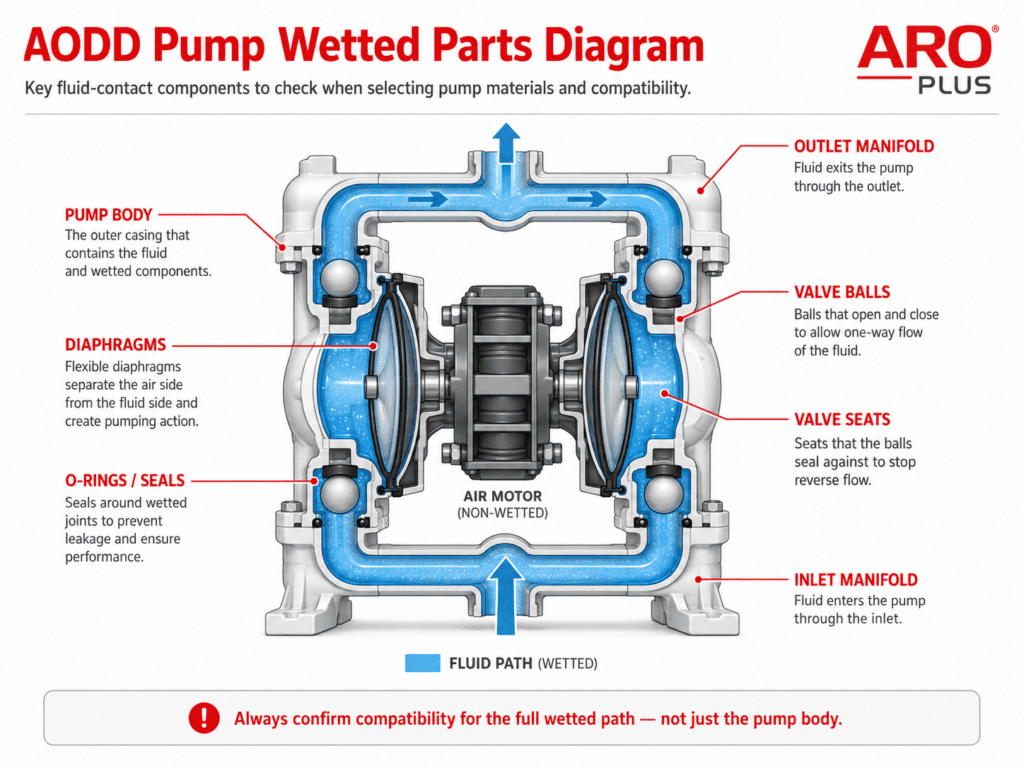
The pump body material is important, but it does not determine compatibility on its own. An AODD pump also contains other wetted components that must be suitable for the fluid.
These may include:
- Diaphragms
- Valve balls
- Seats
- O-rings
- Gaskets
- Manifold seals
For example, a stainless steel pump body may still be unsuitable if the diaphragm material is not compatible with the fluid. Likewise, a polypropylene body may be suitable, but the valve balls or O-rings may need a different material.
A complete AODD pump material selection should consider the full wetted path, not just the body casting.
Other Factors That Affect Material Choice
Material compatibility is not only about the name of the chemical. Several operating conditions can affect whether a material is suitable.
Chemical Concentration
A material may be suitable for a chemical at one concentration but unsuitable at another. Always check the actual concentration being transferred.
Temperature
Higher temperatures can reduce chemical resistance and shorten component life. Temperature also affects diaphragms, elastomers and seals.
Solids and Abrasion
A chemically compatible material may still wear quickly if the fluid contains abrasive solids. Balls, seats and diaphragms may need additional consideration.
Viscosity
Thicker fluids can increase pump load and reduce flow. Material compatibility may be correct, but the pump still needs to be sized properly.
[Internal link: Pressure Loss Calculator]
Cleaning Chemicals
Food, beverage, pharmaceutical and process applications may expose the pump to both the product and cleaning chemicals. Both need to be considered.
Installation Environment
Outdoor exposure, washdown, impact risk, pipework stress and hazardous area classification can all influence the correct pump material.
Hazardous Areas and Conductivity
Some AODD pump applications involve flammable liquids, vapours, gases, mists or combustible dusts. In these environments, pump material selection must also consider static discharge, bonding, earthing and hazardous area suitability.
Metallic pumps are generally easier to bond and earth. Non-metallic pumps may require conductive versions or additional checks depending on the application and site classification.
For potentially explosive atmospheres, check ATEX and explosive atmospheres guidance and confirm whether an ATEX-rated pump is required before selecting the final model.
Chemical Handling and Site Safety
When working with chemicals, pump material compatibility is only one part of the wider selection process. The site should also consider safe handling, exposure controls, maintenance access, spillage risk and operator protection.
For hazardous substances, refer to COSHH guidance and complete the appropriate site risk assessment before installation or use.
How to Choose Between Aluminium, Stainless Steel, Polypropylene and PVDF
As a general starting point:
Choose aluminium when the fluid is non-corrosive, the duty is general industrial transfer and a lightweight, cost-effective pump is suitable.
Choose stainless steel when the application needs strength, durability, corrosion resistance, washdown suitability or hygienic construction.
Choose polypropylene when the application involves compatible acids, alkalis or water-based chemicals and a practical chemical-resistant pump is required.
Choose PVDF when the fluid is more aggressive and needs a higher-performance chemical-resistant material than polypropylene can provide.
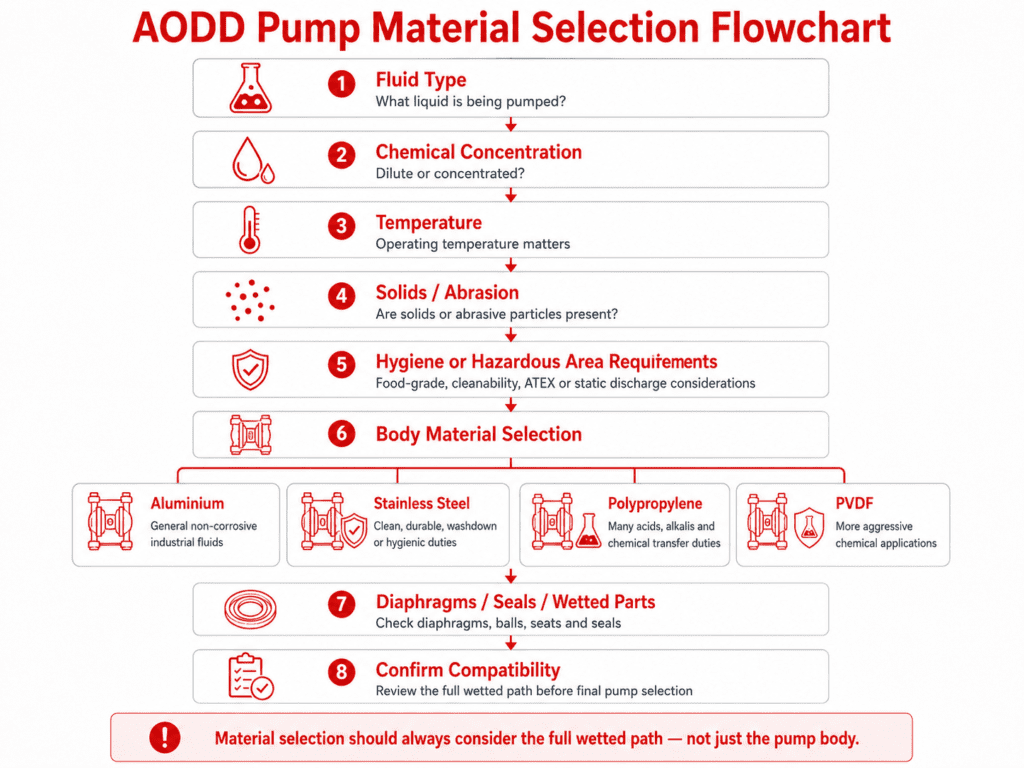
The safest approach is to start with the fluid and operating conditions, then work backwards to the correct body material, diaphragm material and seal arrangement.
Manufacturer ranges such as ARO diaphragm pumps include different body material and construction options, so the final pump should be matched to the application rather than selected by material alone.
A Practical AODD Pump Material Selection Checklist
Before selecting an AODD pump material, confirm:
- What fluid is being pumped?
- What is the chemical concentration?
- What is the operating temperature?
- Are there solids or abrasive particles?
- Is the fluid flammable?
- Is the pump being used in a hazardous area?
- Is the application food-grade, hygienic or high-purity?
- What flow rate and discharge pressure are required?
- Will the pump be installed indoors or outdoors?
- Is the pump exposed to washdown, impact or pipework stress?
- What diaphragm, ball, seat and seal materials are required?
- Has chemical compatibility been checked before final selection?
This checklist helps prevent material selection from being based on body material alone.
Common AODD Pump Material Selection Mistakes
One common mistake is choosing the pump material based only on cost. Aluminium may be cost-effective, but it can quickly become the wrong choice if the fluid attacks the pump body.
Another mistake is assuming stainless steel is suitable for every chemical. Stainless steel is strong and corrosion resistant, but some chemicals and cleaning conditions can still cause compatibility issues.
It is also common to use polypropylene as a default chemical pump material without checking temperature, solvent compatibility, static discharge or mechanical strength.
The most important mistake to avoid is focusing only on the pump body. Diaphragms, balls, seats, O-rings and seals are also wetted parts, so they must be checked as part of the full pump specification.
Speak to Aroplus About AODD Pump Materials
Selecting the right AODD pump material depends on more than choosing between aluminium, stainless steel, polypropylene and PVDF. The correct choice depends on the fluid, concentration, temperature, required performance, installation environment and all wetted components inside the pump.
Aroplus can help review your application and guide you towards a suitable pump body material, diaphragm material and accessory setup.
For chemical or critical applications, always check compatibility before ordering and speak to Aroplus if you are unsure which material is suitable.