
How to Choose the Right AODD Pump for Your Application
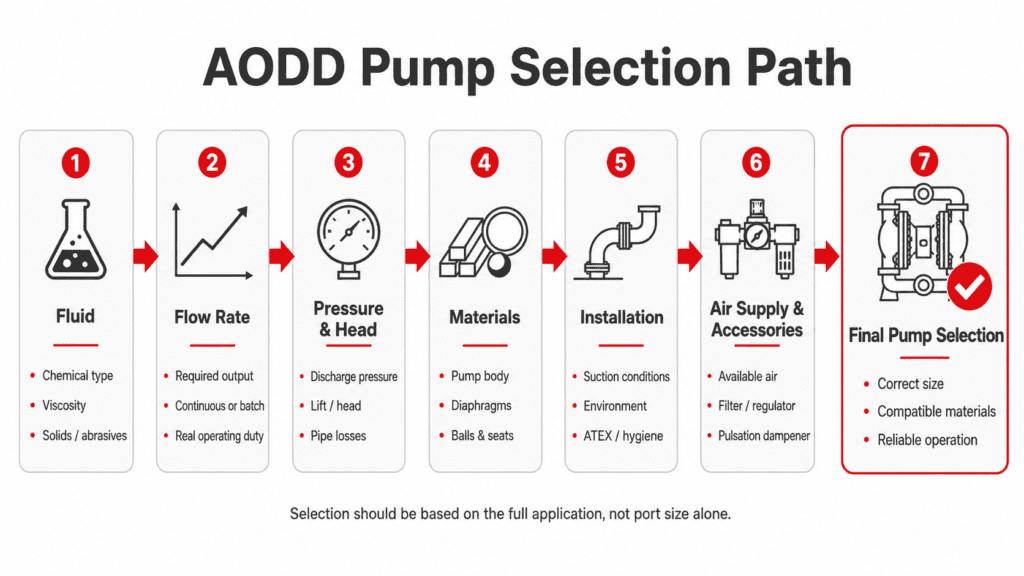
This AODD pump selection guide explains how to choose the right air operated double diaphragm pump for your application. The correct pump depends on the fluid being handled, required flow rate, discharge pressure, suction conditions, wetted materials, air supply and installation environment.
Air operated double diaphragm pumps, often shortened to AODD pumps, are one of the most versatile pump types used across industrial fluid handling. They are commonly selected for chemical transfer, wastewater handling, food and beverage production, manufacturing processes, bund emptying, drum transfer, and many other duties where a simple, robust, self-priming pump is required.
However, choosing the right AODD pump is not just a case of matching the port size to the pipework. The correct pump depends on the fluid, flow rate, discharge pressure, suction conditions, materials of construction, air supply, installation environment, and the way the pump will be used day to day.
This guide explains the main factors to check before choosing an AODD pump, helping you narrow down the correct pump type, size, and specification for your application.
What Is an AODD Pump?
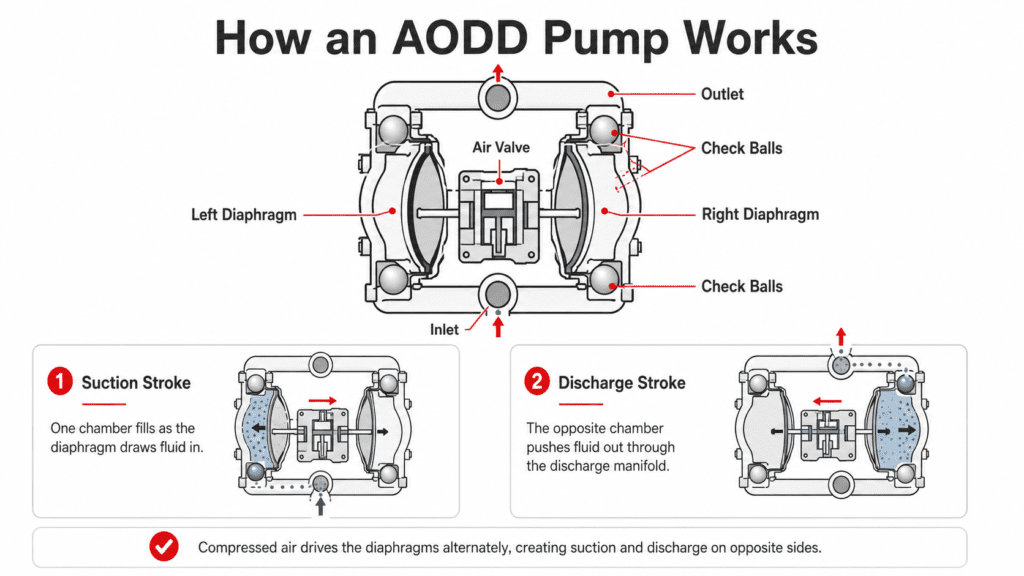
An AODD pump is a positive displacement pump powered by compressed air. Inside the pump, two flexible diaphragms move backwards and forwards. As one diaphragm draws fluid into one chamber, the other diaphragm pushes fluid out of the opposite chamber. Check balls or valves control the direction of flow through the pump.
Because the fluid is moved by diaphragm action rather than by a rotating impeller, AODD pumps are often suitable for applications involving:
- Corrosive liquids
- Abrasive fluids
- Viscous products
- Fluids containing small solids
- Shear-sensitive liquids
- Batch transfer
- Drum or IBC emptying
- Hazardous or ATEX-rated areas
- Intermittent operation
- Self-priming duties
AODD pumps are also seal-less. This means they do not use a mechanical seal in the same way that many centrifugal pumps do. For many industrial duties, this can reduce the risk of seal leakage and make maintenance more straightforward.
When Is an AODD Pump a Good Choice?
An AODD pump is usually worth considering when the application needs flexibility, dry self-priming, variable flow, or resistance to difficult fluids.
Typical examples include:
- Transferring chemicals from tanks, IBCs, or process vessels
- Moving wastewater, sludge, or process effluent
- Feeding liquids into mixing or batching systems
- Emptying sumps, bunds, drums, or containers
- Pumping adhesives, resins, oils, inks, paints, or coatings
- Handling food-grade or hygienic fluids with the correct sanitary pump construction
- Moving fluids in hazardous areas where electric equipment may not be suitable
- Temporary transfer where portability is useful
- Applications where the pump may occasionally run dry
However, an AODD pump is not always the best option. For very high continuous flow rates, very high discharge pressures, or duties where extremely smooth flow is required, another pump type or additional accessories may be needed. For example, pulsation dampeners can help reduce flow pulsation, while high-pressure diaphragm pump designs may be required for duties beyond the limits of a standard 1:1 AODD pump.
Step 1: Understand the Fluid Being Pumped
The fluid is the starting point for any AODD pump selection. Before looking at pump size or price, you need to understand what the pump is actually moving.
The most important fluid details are:
- Chemical name or product type
- Concentration
- Temperature
- Viscosity
- Specific gravity
- Solids content
- Particle size
- Abrasiveness
- Whether the fluid is flammable or hazardous
- Whether the product is food-grade, hygienic, or pharmaceutical
- Whether the product is shear-sensitive
- Whether the fluid can crystallise, settle, or harden
A pump that is suitable for clean water may be completely unsuitable for a solvent, acid, slurry, adhesive, oil, or food product. The same applies to the internal parts of the pump. The body, diaphragms, balls, seats, seals, and manifolds all need to be compatible with the fluid.
Why this matters
If the fluid is chemically aggressive, the wrong material choice can lead to swelling, cracking, corrosion, leakage, or premature diaphragm failure.
If the fluid is abrasive, the pump may need more durable elastomers, suitable ball and seat materials, and a realistic operating speed.
If the fluid is viscous, the pump may need a larger port size, slower cycling speed, and carefully designed suction pipework.
If the fluid contains solids, the pump must be selected with enough passage clearance and suitable check valve materials.
If the product is food-grade or pharmaceutical, the pump may need a sanitary construction, suitable certification, and cleanable surfaces.
Step 2: Define the Required Flow Rate
The flow rate is usually expressed in litres per minute, cubic metres per hour, or gallons per minute. For Aroplus customers in the UK, litres per minute and cubic metres per hour are normally the most useful units.
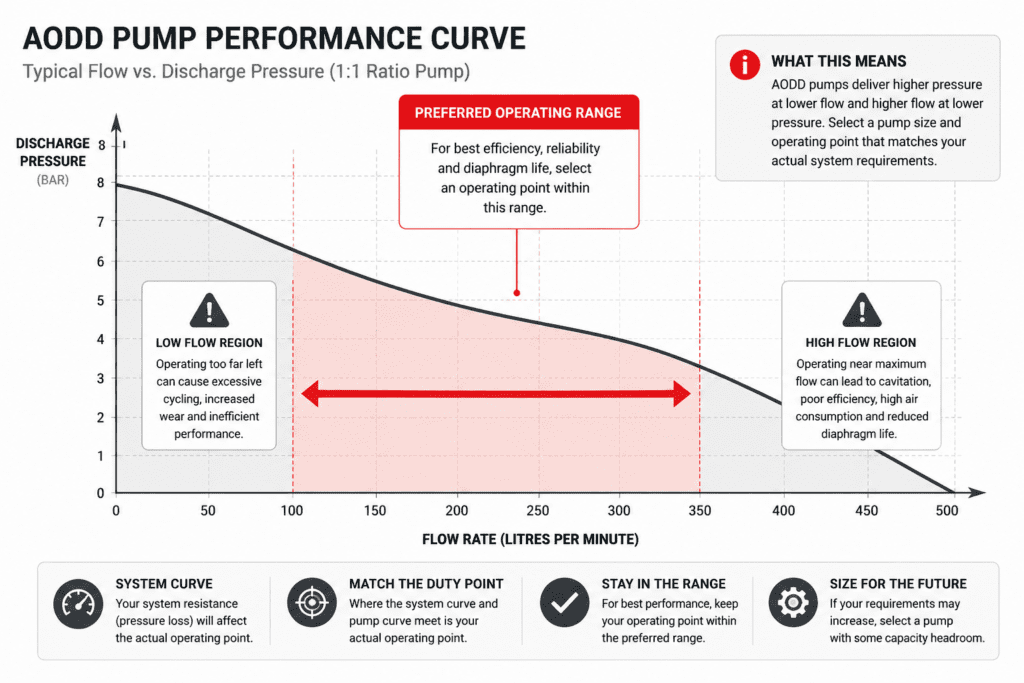
A common mistake is to select a pump based only on the maximum flow rate shown in a catalogue. A pump’s maximum flow is usually measured under ideal test conditions, often with water and minimal discharge resistance. Real installations usually have pipe friction, fittings, suction lift, discharge head, valves, hose runs, filters, viscosity effects, and other restrictions.
Instead of asking “What is the maximum flow this pump can produce?”, it is better to ask:
- What flow rate do we actually need at the process?
- Is the duty continuous or intermittent?
- Is the pump filling a vessel, feeding a process, recirculating, or emptying a container?
- How quickly does the transfer need to happen?
- Will the pump normally run slowly, moderately, or near maximum output?
- Is there a minimum or maximum acceptable flow rate?
For long pump life, it is usually better to avoid selecting a pump that must run at its absolute maximum capacity throughout normal operation. A larger pump running at a sensible cycle rate may often be a better choice than a smaller pump working flat out.
Step 3: Calculate the Pressure and Head Requirements
An AODD pump must overcome the resistance in the system. This includes vertical lift, pipe friction, valves, fittings, filters, hose losses, static head, and pressure inside the receiving vessel if applicable.
The key pressure factors are:
- Suction lift
- Discharge height
- Pipe length
- Pipe diameter
- Number of bends and fittings
- Hose size and length
- Valves and restrictions
- Filter or strainer pressure drop
- Fluid viscosity
- Required pressure at the discharge point
For a simple transfer from one open container to another, the pressure requirement may be modest. For a long pipe run, viscous product, high discharge point, or restrictive nozzle, the pressure requirement may be much higher.
Standard 1:1 AODD Pumps
Most standard AODD pumps are 1:1 ratio pumps. This means the fluid discharge pressure is broadly related to the air pressure supplied to the pump, allowing for losses and real operating conditions. For example, if the pump is supplied with regulated compressed air, the fluid pressure will be controlled by the available air pressure and the system resistance.
Where higher discharge pressure is needed, a high-pressure diaphragm pump or another pump technology may be required.
Avoid underestimating friction loss
Friction loss is often underestimated. Long pipe runs, small bore pipework, flexible hose, quick-release couplings, elbows, and filters can all restrict flow. This is especially important when pumping viscous fluids.
Where pressure loss is unclear, use a pressure loss calculation or ask for technical help before selecting the pump.
Step 4: Check the Suction Conditions
Suction conditions have a major effect on AODD pump performance. Even though AODD pumps are self-priming, they still need suitable installation conditions to perform reliably.
Check:
- Is the pump flooded suction or suction lift?
- How high does the pump need to lift the fluid?
- Is the suction line short and direct?
- Is the suction pipework at least the same size as the pump inlet?
- Is the fluid viscous?
- Is there a strainer on the suction side?
- Could the suction line block or collapse?
- Is there air ingress on the suction side?
- Is the pump emptying from drums, IBCs, tanks, pits, or sumps?
A flooded suction arrangement is usually easier for the pump than suction lift. With suction lift, the pump must create enough vacuum to pull the liquid up into the pump. The higher the suction lift, the more difficult the duty becomes.
For viscous products, suction lift should be treated carefully. A product that flows easily under gravity may still be difficult to pull through a long suction hose.
Good suction-side practice
Keep the suction line as short as possible, avoid unnecessary bends, avoid undersized pipework, and make sure fittings are airtight. If the pump is struggling to prime, the issue is often on the suction side rather than with the pump itself.
Step 5: Consider Viscosity, Solids, and Abrasion
AODD pumps can handle a wide range of fluids, but viscosity and solids must still be considered carefully.
Viscosity
Viscosity describes how resistant a fluid is to flow. Water has low viscosity. Oils, adhesives, syrups, resins, and gels have higher viscosity.
As viscosity increases:
- Flow rate usually reduces
- Suction performance becomes more difficult
- Pipe friction increases
- Larger pipework may be needed
- A larger pump may be required
- The pump may need to run at a slower cycle rate
For viscous fluids, do not select the pump from water performance alone. The pump may need to be oversized to achieve the required real-world flow.
Solids
If the fluid contains solids, check the size, shape, hardness, and concentration of those solids.
Consider:
- Maximum particle size
- Whether solids are soft or hard
- Whether solids settle when the pump stops
- Whether the fluid is a slurry
- Whether the solids are abrasive
- Whether the pump needs flap valves instead of ball valves
Some AODD pumps are better suited to solids handling than others. Ball and seat design, valve clearance, pump size, and material selection all matter.
Abrasion
Abrasive fluids can wear diaphragms, balls, seats, and manifolds. Examples include wastewater sludge, ceramic slips, pigments, certain powders in suspension, and process slurries.
For abrasive duties, the selection should prioritise durability, sensible pump speed, suitable elastomers, and easy maintenance access.
Step 6: Choose the Correct Pump Body Material
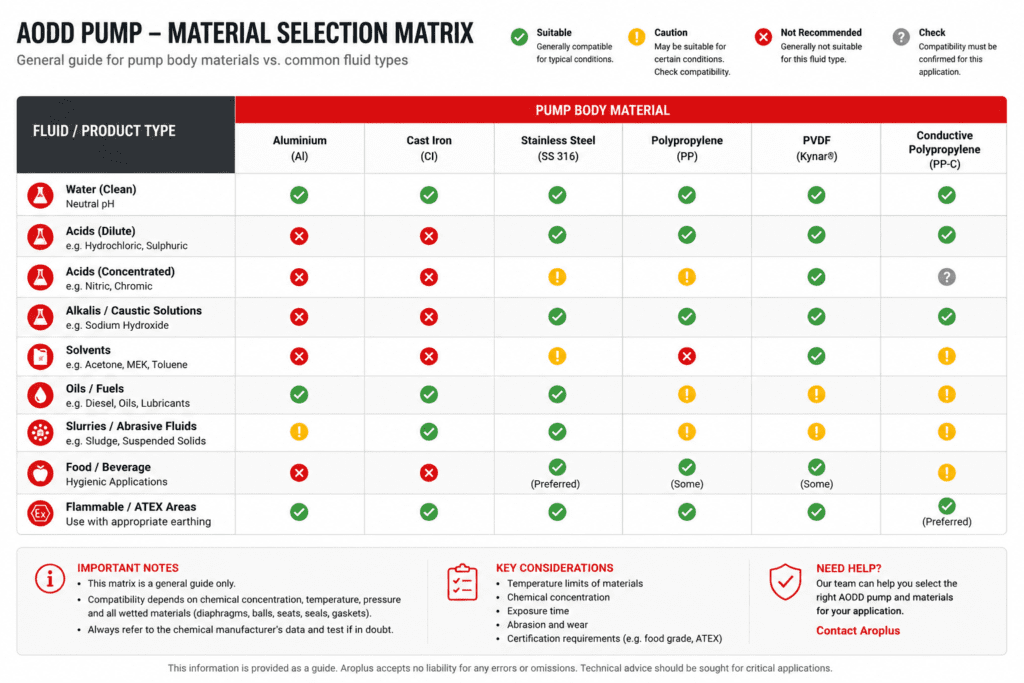
The pump body, also called the wetted housing or fluid section, must be compatible with the product being pumped and the surrounding environment.
Common AODD pump body materials include:
| Pump body material | Typical use |
|---|---|
| Aluminium | Oils, fuels, non-corrosive industrial fluids, general transfer |
| Cast iron | Robust industrial duties, non-corrosive fluids, wastewater-type applications |
| Stainless steel | Chemicals, solvents, hygienic duties, food-grade or washdown environments |
| Polypropylene | Many acids, alkalis, chemical transfer, corrosive fluids |
| PVDF | More aggressive chemicals where polypropylene is not suitable |
| Conductive plastics | Certain hazardous or ATEX-sensitive chemical applications |
| Sanitary stainless steel | Food, beverage, cosmetics, pharmaceutical and cleanable process duties |
This table should be treated as a starting point only. Chemical compatibility depends on the exact fluid, concentration, temperature, and all wetted materials.
Metallic vs non-metallic pumps
Metallic pumps are often chosen for strength, temperature resistance, grounding, durability, and robust industrial environments.
Non-metallic pumps are often chosen for chemical resistance and corrosion control, especially with acids, alkalis, and aggressive cleaning agents.
Stainless steel is often the preferred choice for hygienic, food-grade, pharmaceutical, cosmetic, and washdown applications, but the internal elastomers and surface finish still need to be checked.
Step 7: Select the Right Diaphragms, Balls, and Seats
Use this AODD pump selection guide as a starting point before comparing individual pump models, materials and accessories. The internal wear parts are just as important as the outer pump body. A pump body may be chemically compatible, but the diaphragm, balls, seats, and seals must also be suitable.
Common diaphragm and elastomer options include:
| Material | Typical considerations |
| PTFE | Often used for aggressive chemicals and solvents; less flexible than some elastomers |
| Santoprene | Common general-purpose option for many water-based and mild chemical duties |
| EPDM | Often considered for water-based chemicals, cleaning fluids, and some hygienic duties |
| Nitrile | Often used for oils, fuels, and petroleum-based fluids |
| FKM / Viton | Often used for certain solvents, hydrocarbons, and higher temperature duties |
| Hytrel | Often used where abrasion resistance and flex life are important |
| Food-grade elastomers | Required where product contact and hygiene standards apply |
The ball and seat materials affect sealing, suction performance, solids handling, and wear life. A poor ball/seat choice can lead to loss of prime, poor flow, excessive wear, or leakage back through the pump.
Do note guess on chemical compatibility
When handling chemicals, compatibility should be checked against the exact product, concentration, and temperature. If the chemical is a blend, proprietary product, or cleaning agent, check the safety data sheet and confirm compatibility before ordering.
Step 8: Match the Pump Size and Port Size
AODD pumps are commonly described by port size, such as 1/2″, 1″, 1½”, 2″, or 3″. Port size is useful, but it should not be the only selection method.
A larger port size generally allows greater flow, lower velocity, and better handling of viscous fluids or solids. However, oversized pumps can be less efficient or less controllable if the required flow is very low.
When comparing pump sizes, consider:
- Required flow rate
- Required pressure
- Viscosity
- Solids content
- Pipework size
- Suction conditions
- Air consumption
- Physical space
- Port connection type
- Maintenance access
A pump should be selected for the duty point, not just the pipe size. If the existing pipework is undersized, selecting a larger pump may not solve the problem because the pipework itself may still restrict flow.
Step 9: Check the Available Air Supply
An AODD pump depends on compressed air. If the site air supply cannot support the pump, the pump will not perform as expected.
Check:
- Available air pressure
- Available air volume
- Compressor capacity
- Air line size
- Distance from the compressor or receiver
- Air treatment
- Air regulator and filter arrangement
- Whether other equipment shares the same air supply
- Whether the pump will run continuously or intermittently
A common problem is installing a pump with an air line that is too small. The pump may start, but it will not reach the expected flow rate because it cannot receive enough air volume.
Air preparation
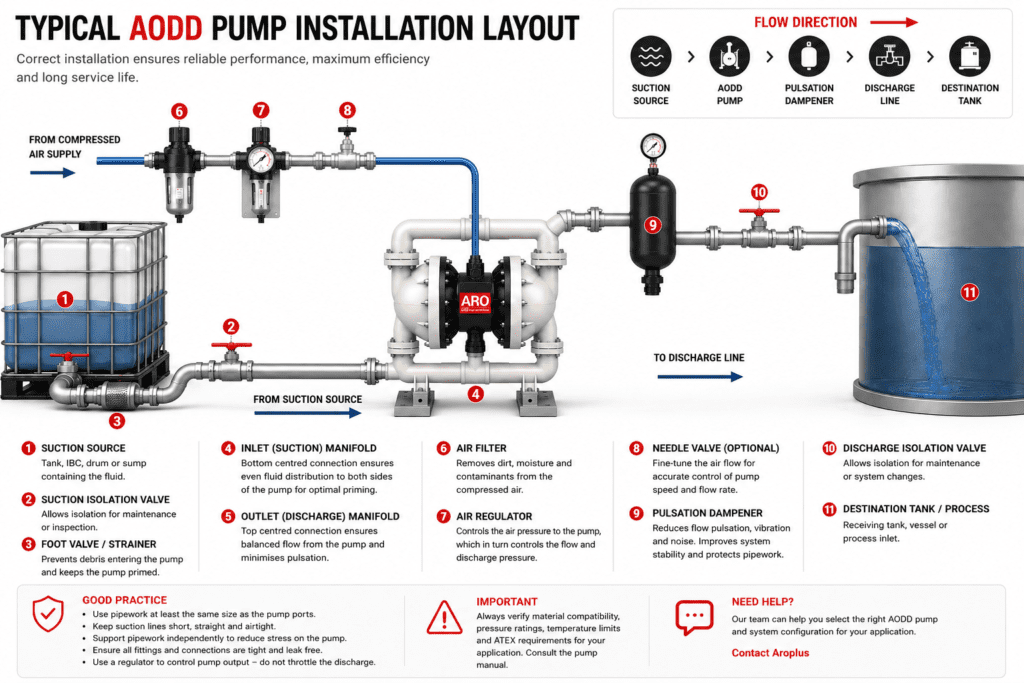
A filter/regulator is normally recommended so the pump receives clean, controlled air. This helps control pump speed, discharge pressure, and general reliability. In some installations, a lubricator, needle valve, or soft-start arrangement may also be appropriate.
Step 10: Consider the Installation Environment
The surrounding environment can affect pump selection just as much as the fluid.
Check whether the pump will be installed in:
- A hazardous area
- An ATEX-rated zone
- A washdown area
- Outdoors
- A dusty environment
- A hot or cold plant room
- A food-grade production area
- A mobile skid or trolley
- A bund, sump, or pit
- A corrosive atmosphere
- A noisy area
- A location with limited maintenance access
For hazardous areas, ATEX requirements must be reviewed properly. Pneumatic pumps are often used in hazardous environments, but the pump construction, grounding, materials, accessories, and full system design must all be suitable for the classified zone.
For hygienic environments, consider cleanability, surface finish, clamp connections, drainability, material certification, and the cleaning process.
For outdoor or harsh environments, consider mounting, corrosion resistance, freezing risk, air exhaust management, and protection from damage.
Step 11: Decide Whether the Pump Needs to Be Hygienic
Food, beverage, cosmetic, personal care, and pharmaceutical applications may need more than a standard industrial pump.
A hygienic or sanitary diaphragm pump may be required when the pumped product comes into contact with the final product or where cleaning standards are critical.
Consider:
- Product contact requirements
- Food-grade wetted materials
- Sanitary clamp connections
- Stainless steel construction
- Surface finish
- Cleanability
- Drainability
- CIP or manual cleaning requirements
- Certification requirements
- Risk of contamination
- Batch traceability
Do not assume that any stainless steel AODD pump is automatically suitable for food production. The internal materials, design, finish, and cleaning method all need to be appropriate.
Step 12: Think About Pulsation and Flow Control
AODD pumps naturally produce a pulsed flow because of the reciprocating diaphragm movement. For many transfer applications, this is acceptable. For others, it may need to be controlled.
Pulsation may matter if the pump is feeding:
- Flow meters
- Filling heads
- Spray nozzles
- Filters
- Dosing systems
- Heat exchangers
- Sensitive process equipment
- Long pipe runs
A pulsation dampener can smooth the flow and reduce pressure spikes. This can help protect pipework, improve process stability, and reduce vibration.
Flow can also be controlled by adjusting air pressure, air volume, and discharge conditions. However, the control method should be suitable for the process. Simply restricting the discharge may not be the best way to manage every application.
Step 13: Plan for Maintenance and Spare Parts
AODD pumps are generally straightforward to maintain, but maintenance should still be considered during selection.
Check:
- How often the pump will run
- Whether it will run continuously or intermittently
- Whether the fluid is abrasive
- Whether the pump is critical to production
- Whether downtime is costly
- Whether service kits are available
- Whether the pump is easy to access
- Whether the site team can carry out routine maintenance
- Whether genuine spare parts are required
- Whether the pump has diaphragms, balls, seats, and seals available from stock
For critical duties, it may be sensible to keep common wear parts on site. This can include diaphragms, balls, seats, gaskets, O-rings, and service kits.
A pump that is cheap to buy but difficult to maintain can become expensive over time. The best selection should consider lifecycle cost, not purchase price alone.
Common AODD Pump Selection Mistakes
1. Choosing by port size only
Common AODD Pump Selection Mistakes
1. Choosing by port size only
A 2″ pump is not automatically the right choice just because the pipework is 2″. The duty point, fluid, suction conditions, and air supply matter.
2. Selecting from maximum catalogue flow
Maximum flow figures are useful for comparison, but they do not represent every real-world installation. Always consider the actual pressure and system resistance.
3. Ignoring chemical compatibility
The wrong diaphragm or ball material can fail quickly, even if the pump body looks suitable.
4. Undersizing the air supply
AODD pumps need enough air volume as well as pressure. Small air lines, long air runs, or overloaded compressors can limit pump performance.
5. Forgetting suction conditions
A pump may be capable of self-priming, but poor suction pipework can still cause priming problems, low flow, or erratic operation.
6. Running the pump too fast
A pump running at high speed may wear faster, consume more air, and create more pulsation. A larger pump running more slowly may be better for long-term reliability.
7. Overlooking accessories
A filter/regulator, pulsation dampener, strainer, hose reel, or control system may be essential for the application, even if the pump itself is correctly selected.
8. Treating all stainless steel pumps as hygienic
Hygienic duties need the correct pump design, materials, connections, finish, and cleaning approach.
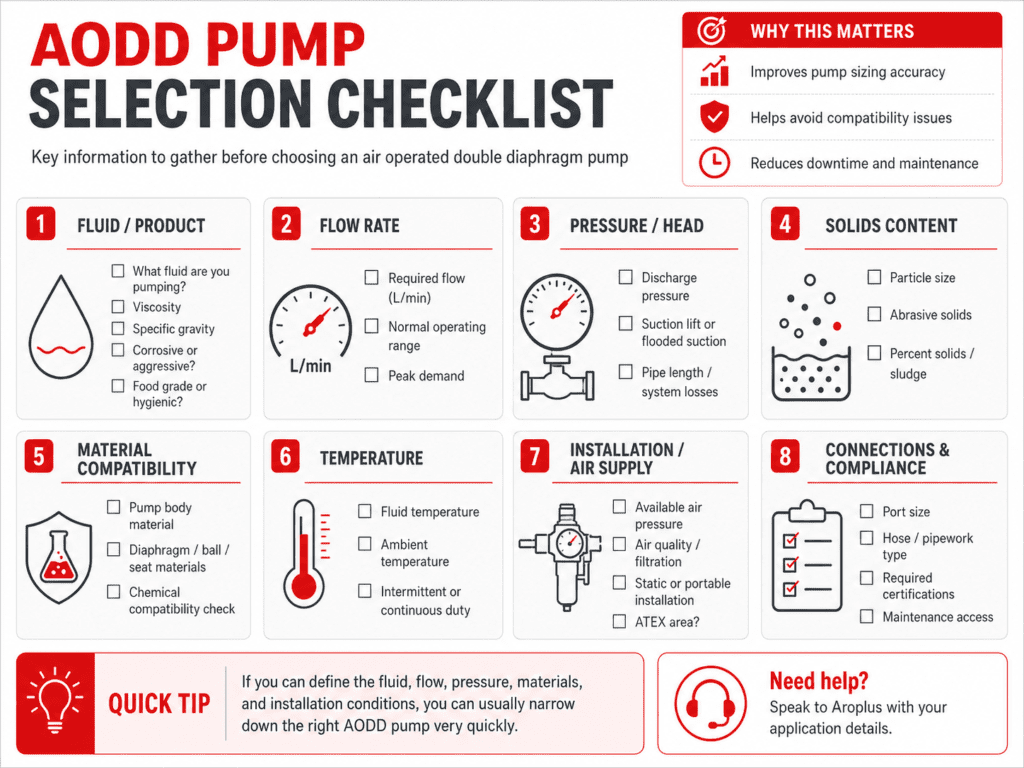
Quick AODD Pump Selection Checklist
Before choosing a pump, gather the following information:
Fluid details
- Product name
- Chemical concentration
- Temperature
- Viscosity
- Specific gravity
- Solids content
- Particle size
- Abrasiveness
- Shear sensitivity
- Hygiene requirements
- Hazardous classification
Duty requirements
- Required flow rate
- Required discharge pressure
- Suction lift or flooded suction
- Discharge height
- Pipe length and diameter
- Hose length
- Number of bends and fittings
- Batch or continuous operation
- Expected operating hours
Pump specification
- Body material
- Diaphragm material
- Ball material
- Seat material
- Port size
- Connection type
- ATEX requirement
- Sanitary requirement
- Service kit availability
Site conditions
Site conditions
- Available air pressure
- Available air volume
- Air line size
- Air treatment
- Installation location
- Maintenance access
- Noise considerations
- Environment temperature
- Washdown or outdoor exposure
Accessories
- Filter/regulator
- Pulsation dampener
- Suction strainer
- Isolation valves
- Flexible connectors
- Hose reels
- Cycle counter
- Leak detection
- Service kits
- Spare diaphragms, balls, seats, and seals
Example Selection Scenarios
Chemical transfer from IBC's
A site needs to transfer corrosive liquid from IBCs into a process tank. The main priorities are chemical compatibility, safe operation, and reliable suction from a container.
Likely selection considerations:
- Polypropylene, PVDF, stainless steel, or other compatible wetted material
- PTFE or another suitable diaphragm material
- Correct ball and seat material
- ATEX review if the fluid is flammable
- Suitable suction lance or hose
- Filter/regulator on the air supply
- Chemical compatibility confirmation before purchase
Wastewater or sludge transfer
A site needs to transfer wastewater containing solids. The main priorities are solids handling, abrasion resistance, and ease of maintenance.
Likely selection considerations:
- Robust metallic or non-metallic construction depending on the fluid
- Suitable ball and seat design
- Solids passage capability
- Abrasion-resistant wear parts
- Accessible installation for maintenance
- Strainer choice reviewed carefully to avoid blockage
- Realistic pump speed to reduce wear
Food-grade product transfer
A food manufacturer needs to transfer a viscous product between vessels. The main priorities are hygiene, cleanability, product protection, and material compliance.
Likely selection considerations:
- Sanitary stainless steel pump construction
- Food-grade diaphragms and elastomers
- Suitable clamp connections
- Cleanability and drainability
- Low-shear handling
- Viscosity derating
- Cleaning procedure compatibility
- Documentation and certification requirements
Resin, adhesive, or coating transfer
A manufacturing site needs to move a viscous product from a drum to a process line. The main priorities are viscosity handling, suction performance, and controlled flow.
Likely selection considerations:
- Larger pump size than water flow alone might suggest
- Short, wide suction hose
- Suitable diaphragm and ball materials
- Slow, controlled pump speed
- Pulsation dampener if feeding equipment
- Maintenance plan to prevent product curing inside the pump
Should You Choose an Air Operated or Electric Diaphragm Pump?
AODD pumps are powered by compressed air, while electric diaphragm pumps use an electric drive. Both can be useful, but the correct choice depends on the site and application.
An AODD pump may be preferred where:
- Compressed air is readily available
- The area is hazardous or requires pneumatic equipment
- The duty is intermittent
- Dry self-priming is important
- Simple speed control is required
- Portability is useful
- The pump may be used across multiple duties
An electric diaphragm pump may be preferred where:
- Energy efficiency is a major concern
- Continuous duty is expected
- Compressed air is limited or expensive
- More controlled operation is required
- The process benefits from electric drive control
- Air exhaust is not desirable
The right choice should be based on the total duty, not only the pump purchase cost.
Final Thoughts: Choose the Pump Around the Application
The best AODD pump is not simply the cheapest pump, the largest pump, or the pump with the closest port size. It is the pump that matches the real application.
A good selection should consider:
- What the fluid is
- How fast it needs to move
- How far and how high it needs to be pumped
- Whether the product is corrosive, abrasive, viscous, hazardous, or hygienic
- Which materials are compatible
- Whether the site air supply is suitable
- Whether the installation needs accessories
- How the pump will be maintained over time
For straightforward transfer duties, selection may be simple. For chemical, hygienic, hazardous, viscous, abrasive, or critical process applications, it is worth checking the specification before ordering.
Aroplus can help identify the correct AODD pump, wetted materials, spare parts, service kits, and supporting accessories for your application.
Need Help Choosing an AODD Pump?
If you are unsure which diaphragm pump is right for your fluid, process, or site conditions, speak to Aroplus for technical pump support.
Provide as much information as possible, including the fluid, flow rate, suction conditions, discharge requirements, available air supply, and any material or certification requirements.