
COMPRESSORS · TECHNICAL ADVICE
How Air Compressors Work: A Comprehensive Guide
A practical guide to compression methods, air treatment, storage, controls and distribution.
Compressed air powers pneumatic tools, production machinery, control valves, packaging equipment and automated processes across almost every industrial sector. However, the compressor itself is only one part of the system that delivers usable compressed air to the point of demand.
A complete compressed air installation may include the compressor, electric motor, control system, coolers, moisture separators, an air receiver, dryers, filters and distribution pipework. Each component affects the pressure, airflow, air quality, energy consumption and reliability of the final air supply.
This guide explains how air compressors work, how the main compressor technologies differ and what happens to the air between entering the compressor and reaching the equipment that uses it.
In This Guide
What Does an Air Compressor Do?
An air compressor draws in atmospheric air and increases its pressure so that it can be stored and used as a source of energy.
In a positive-displacement compressor, a quantity of air is trapped inside a chamber. The available space inside that chamber is then reduced mechanically. As the volume decreases, the air pressure increases.
Dynamic compressors work differently. Instead of trapping a fixed volume of air, they accelerate a continuous stream using a high-speed impeller. The velocity of the moving air is then converted into pressure.
The two main compressor families are:
- Positive-displacement compressors, including piston, rotary screw and scroll compressors.
- Dynamic compressors, including centrifugal and axial compressors.
Most workshops, manufacturing facilities and general industrial sites use positive-displacement compressors. Dynamic compressors are more commonly associated with very large and relatively constant airflow demands.
The Compressed Air Process at a Glance
A typical industrial compressed air system follows this route:
Atmospheric air → intake filter → compressor → aftercooler → moisture separator → air receiver → dryer → filters → distribution pipework → point of use
The exact arrangement varies depending on the compressor technology, air-quality requirement and site layout. However, dependable compressed air normally requires more than simply generating pressure.
The air must also be:
- Cooled after compression
- Separated from condensed moisture
- Stored to help manage demand
- Dried and filtered to the required quality
- Distributed without excessive leakage or pressure loss
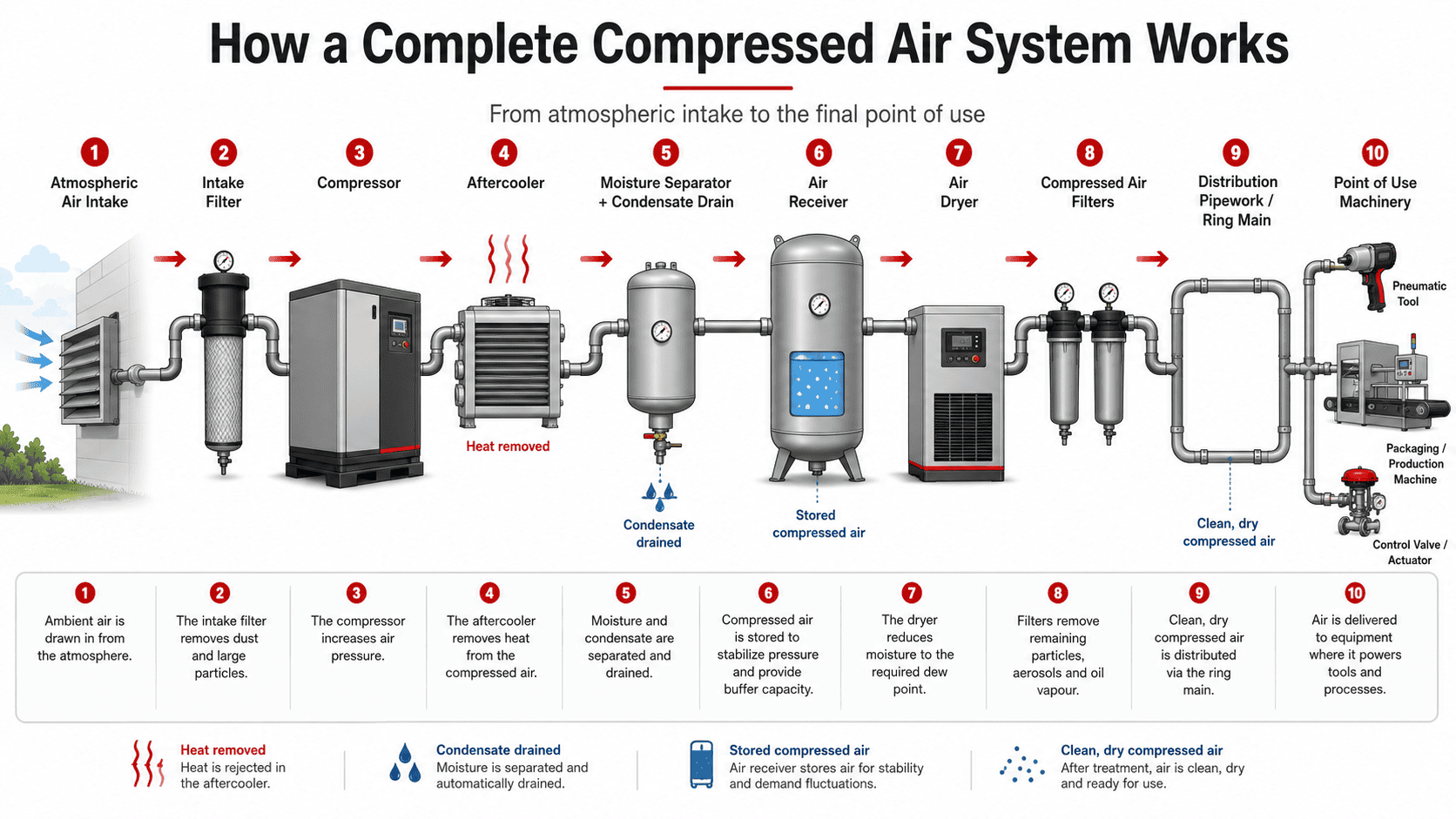
The main stages of a complete industrial compressed air system, from atmospheric intake to the final point of use.
Step 1: Atmospheric Air Enters the Compressor
The compression process begins when surrounding air is drawn through the compressor inlet.
Ambient air contains more than oxygen and nitrogen. Depending on the installation environment, the intake air may also contain:
- Dust
- Water vapour
- Oil vapour
- Exhaust fumes
- Process contaminants
- Other airborne particles
An intake filter captures larger solid contaminants before they enter the compression chamber. This helps protect the air end and maintain compressor performance.
The compressor should receive clean, cool air from a suitably ventilated location. Excessive ambient temperature, blocked ventilation or contamination around the intake can increase operating temperature and reduce equipment reliability.
Step 2: The Motor Drives the Compressor Air End
Most industrial compressors are driven by an electric motor.
The motor converts electrical energy into mechanical movement and transfers it to the compressor air end using one of several arrangements:
- Direct drive
- Belt and pulley drive
- Gear drive
- Flexible coupling
The air end is the part of the compressor where the air is physically compressed. Its internal design depends on whether the machine uses pistons, rotary screws, scrolls or centrifugal impellers.
The compressor motor and air end must be correctly matched. The motor must provide enough power to start the compressor and deliver the required pressure and airflow under normal operating conditions.
Step 3: The Air Is Compressed
The way in which the volume of air is reduced depends on the compressor technology. Piston, rotary screw and scroll compressors all use positive displacement, while centrifugal compressors increase pressure by accelerating a continuous stream of air.
How Piston Air Compressors Work
A piston compressor uses a piston moving backwards and forwards inside a cylinder.
During the intake stroke:
- The piston moves away from the cylinder head.
- The inlet valve opens.
- Atmospheric air enters the cylinder.
During the compression stroke:
- The inlet valve closes.
- The piston moves towards the cylinder head.
- The available volume inside the cylinder becomes smaller.
- The air pressure increases.
- The discharge valve opens once the required pressure is reached.
The compressed air then leaves the cylinder and passes towards the receiver or downstream system.
Because the compression process takes place in repeated cycles, piston air compressors are often well suited to intermittent demand. Typical applications include garages, maintenance areas, smaller workshops and facilities where compressed air is used in shorter bursts.
How Rotary Screw Air Compressors Work
A rotary screw compressor contains two intermeshing helical rotors, commonly referred to as the male and female rotors.
As the rotors turn:
- Air enters at the inlet side of the air end.
- The air becomes trapped between the rotor profiles and the casing.
- The trapped air moves along the length of the rotors.
- The available space becomes progressively smaller.
- The compressed air leaves through the discharge port.
Unlike a piston compressor, the rotary screw process provides a relatively continuous flow of compressed air.
This makes screw air compressors a common choice for production facilities, manufacturing plants and other sites with sustained compressed air demand.
BOGE provides oil-injected and oil-free screw compressor technologies across a broad range of industrial duties.
How Scroll Air Compressors Work
A scroll compressor uses two interleaved spiral elements.
One scroll remains fixed while the other moves in an orbiting motion. This creates a series of sealed air pockets between the two spirals.
As the moving scroll continues to orbit:
- Air enters at the outside edge of the scroll assembly.
- The air becomes trapped in enclosed pockets.
- The pockets move towards the centre.
- Each pocket becomes progressively smaller.
- The compressed air exits through a central discharge port.
Scroll compression produces smooth airflow with relatively low vibration and noise.
Scroll air compressors are therefore commonly used in laboratories, medical facilities, electronics production and other installations where low noise, compact design or clean compression is important.
BOGE’s scroll compressor technology uses one stationary spiral and one eccentrically moving spiral to compress the air.
How Centrifugal Air Compressors Work
A centrifugal compressor uses a high-speed rotating impeller rather than a sealed compression chamber.
The impeller accelerates the air and increases its velocity. The moving air then enters a diffuser, where its speed is reduced and the velocity energy is converted into pressure.
Large centrifugal compressors may use several stages, with cooling and moisture separation between each stage.
This technology is generally used for high, relatively stable airflow demands in large industrial facilities.
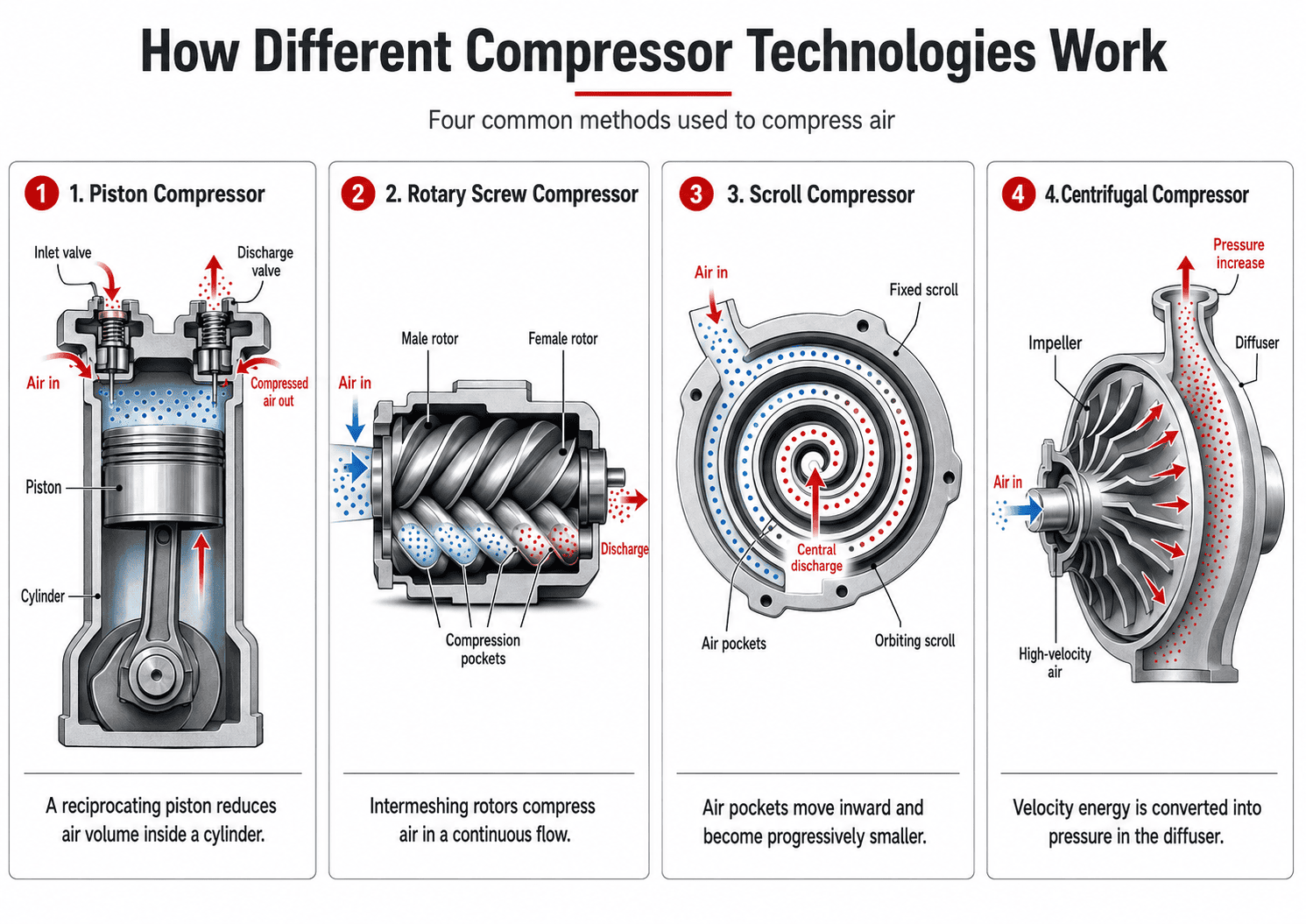
The four principal methods used to increase air pressure inside industrial compressors.
Step 4: Compression Generates Heat
Air becomes hotter when it is compressed.
Mechanical energy is applied to the gas while the air molecules are concentrated into a smaller space. As a result, the air leaving the compression chamber can be significantly hotter than the surrounding atmosphere.
This heat must be controlled to protect:
- Compressor components
- Lubricants
- Downstream dryers and filters
- Distribution pipework
- Pneumatic equipment
Depending on the compressor type and size, cooling may involve:
- Air-cooled heat exchangers
- Water-cooled heat exchangers
- Lubricant cooling
- Intercoolers between compression stages
- An aftercooler after the final compression stage
The compressor room must also have adequate ventilation. Heat removed from the compressed air is transferred into the surrounding cooling air or water, so it must still be removed from the installation area.
In suitable applications, some compressor waste heat may be recovered for space heating, process-water preheating or other low-temperature uses.
Step 5: Lubricant Is Separated in Oil-Injected Screw Compressors
Many rotary screw compressors inject lubricant into the air end.
The lubricant performs several important functions:
- Removes heat from the compression process
- Lubricates internal components
- Helps seal clearances between the rotors
- Reduces mechanical wear
- Supports efficient compression
The discharge leaving the air end therefore contains a mixture of compressed air and lubricant.
This mixture enters a separator vessel, where most of the lubricant is removed. A separator element then captures the remaining lubricant aerosol before the lubricant is cooled, filtered and returned to the air end.
The condition of the separator is important. As the element becomes restricted, the pressure difference across it increases. The compressor must then work against greater internal resistance, which can reduce performance and increase energy consumption.
Oil-injected compression should not be confused with an oil-free air compressor. In an oil-free compressor, lubricant is not introduced into the compression chamber, helping to reduce contamination risk in applications where compressed air purity is especially important.
Oil-injected and oil-free are not the same
Oil-free describes the compression method. It means lubricant is not introduced into the compression chamber. Downstream filtration can remove contaminants from an oil-injected system, but it does not change the compressor into an oil-free compression system.
Step 6: The Compressed Air is Cooled
After leaving the air end, the compressed air normally passes through an aftercooler.
The aftercooler reduces the discharge temperature before the air enters the receiver, dryer or downstream treatment system.
Cooling is important because warm air can hold more water vapour than cooler air. As the compressed air temperature falls, its ability to retain water vapour decreases.
Some of the water vapour then changes into liquid condensate.
The aftercooler therefore performs two connected functions:
- It lowers the temperature of the compressed air.
- It causes water vapour to condense so that it can be separated and drained.
Aftercooling is a key stage in controlling both discharge temperature and moisture within the compressed-air system.
Step 7: Moisture and Condensate Are Removed
Cooling the compressed air does not remove the water from the system by itself. It changes part of the water vapour into liquid, which must then be collected and discharged.
A moisture separator causes the compressed air to change direction or velocity. Liquid droplets are separated from the airflow and collect at the bottom of the separator.
The condensate is then discharged through a drain.
Common drain types include:
- Manual drains
- Timed solenoid drains
- Float-operated drains
- Electronic zero-loss drains
A failed condensate drain can create serious operating problems.
If the drain remains closed, water may pass downstream into the receiver, dryer or distribution system. If the drain remains open, valuable compressed air may be continually lost.
Condensate from an oil-lubricated compressor may contain lubricant and other contaminants. It should therefore be managed correctly rather than assumed to be clean water.
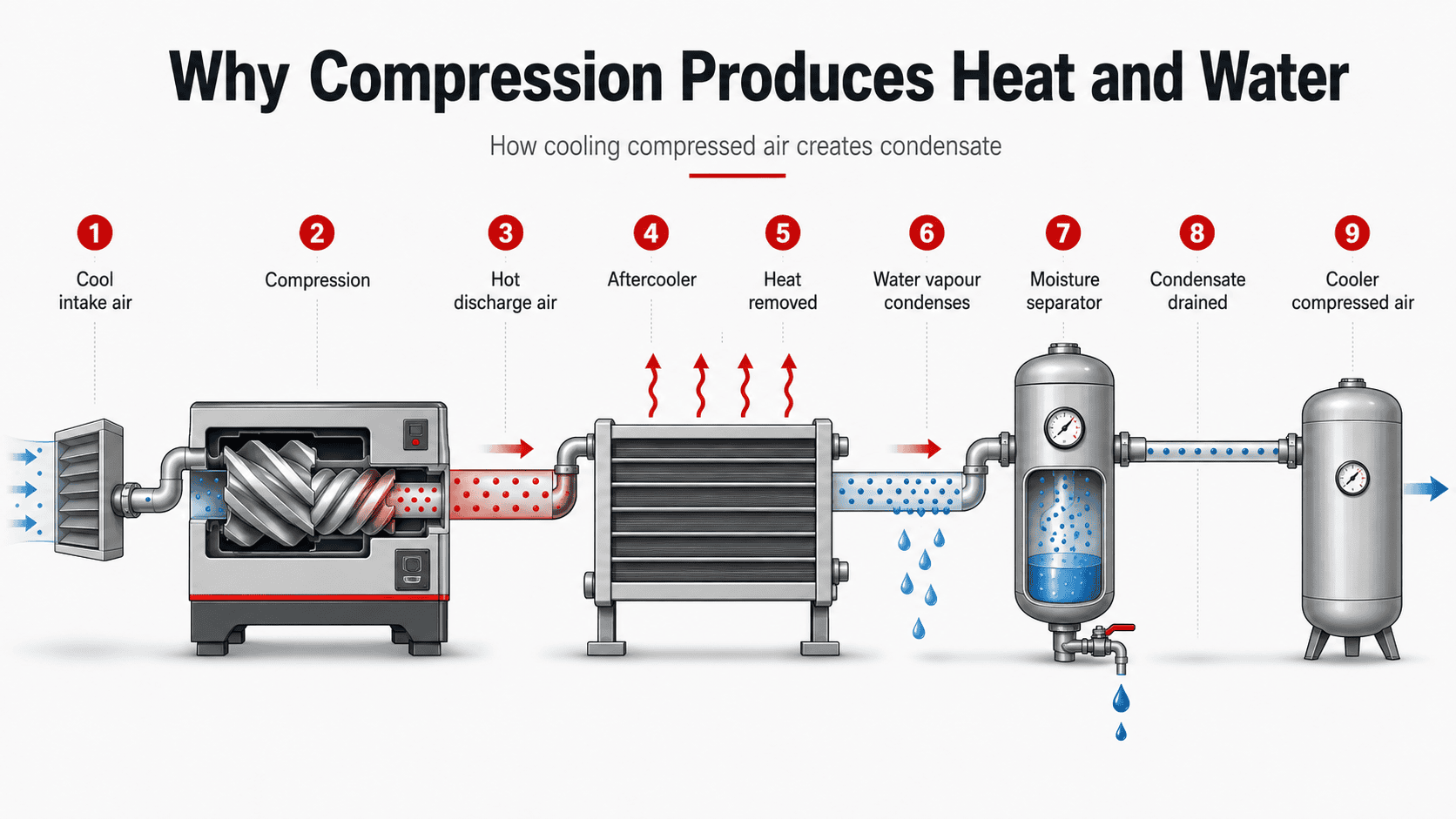
Compression raises the air temperature. When the compressed air is cooled again, water vapour condenses and must be separated and drained.
Step 8: The Air Receiver Stores Compressed Air
An air receiver is a pressure vessel used to store a volume of compressed air.
The receiver does not create additional compressor capacity. Instead, it acts as a buffer between the air being produced by the compressor and the air being consumed throughout the system.
A correctly sized air receiver can:
- Supply short periods of high airflow
- Reduce rapid compressor cycling
- Improve system-pressure stability
- Smooth pulsations from piston compressors
- Allow additional condensate to settle
- Give compressor controls time to respond
- Support efficient load-and-unload operation
Air receivers may be installed immediately after the compressor, before or after the dryer, close to a high-demand application or as additional storage elsewhere in the factory.
The correct receiver size and position depend on the compressor controls, demand profile, treatment arrangement and reason the storage is required.
Because an air receiver contains stored energy, it must be installed, operated and examined in accordance with the applicable pressure-system requirements.
An air receiver does not make the compressor larger
The receiver can temporarily supply stored air during a short peak, but the compressor must eventually replace that air. If the average demand remains greater than the compressor’s output, receiver pressure will continue to fall.
Pressure and Flow Are Not the Same Thing
Pressure and flow are separate measurements, and both must be considered when specifying an air compressor.
A compressor may be capable of reaching the required system pressure while still being unable to supply enough air for all the equipment operating at the same time.
What is Compressed Air Pressure?
Pressure describes the force available within the compressed air system.
It is commonly measured in:
- Bar
- Pounds per square inch, or psi
- Kilopascals, or kPa
The compressor must generate enough pressure to overcome legitimate losses through the dryer, filters, regulators, pipework, hoses and fittings while still delivering the minimum required pressure at the point of use.
Increasing the compressor pressure setting should not be used as a permanent solution for an avoidable restriction elsewhere in the system.
What Is Compressed Air Flow?
Flow describes the volume of air delivered over a period of time.
Common airflow units include:
- Cubic feet per minute, or CFM
- Litres per second
- Litres per minute
- Cubic metres per hour
- Cubic metres per minute
Flow determines whether the compressor can continuously replace the air being consumed by the equipment connected to the system.
A small compressor may be able to fill an idle receiver to 8 bar. However, once several tools or machines begin operating, the stored air may leave the receiver faster than the compressor can replace it.
The receiver pressure will then fall, even though the compressor was initially capable of reaching the correct pressure.
Why Does System Pressure Fall During Production?
Falling pressure does not automatically mean that the compressor pressure setting is too low.
Possible causes include:
- Demand exceeding the compressor’s available airflow
- Insufficient receiver storage
- An undersized distribution pipe
- Restricted filters or dryers
- Small hoses or couplings
- Air leaks
- Several high-demand machines operating simultaneously
- Poorly located storage
Raising the discharge pressure may temporarily hide the problem, but it can also increase compressor power consumption, leakage and unnecessary air use.
The complete compressed air system should be assessed before increasing the pressure setting or installing a larger compressor.
The key distinction
Pressure is the force available. Flow is the quantity of air supplied. Storage provides temporary support but does not replace sufficient compressor capacity.
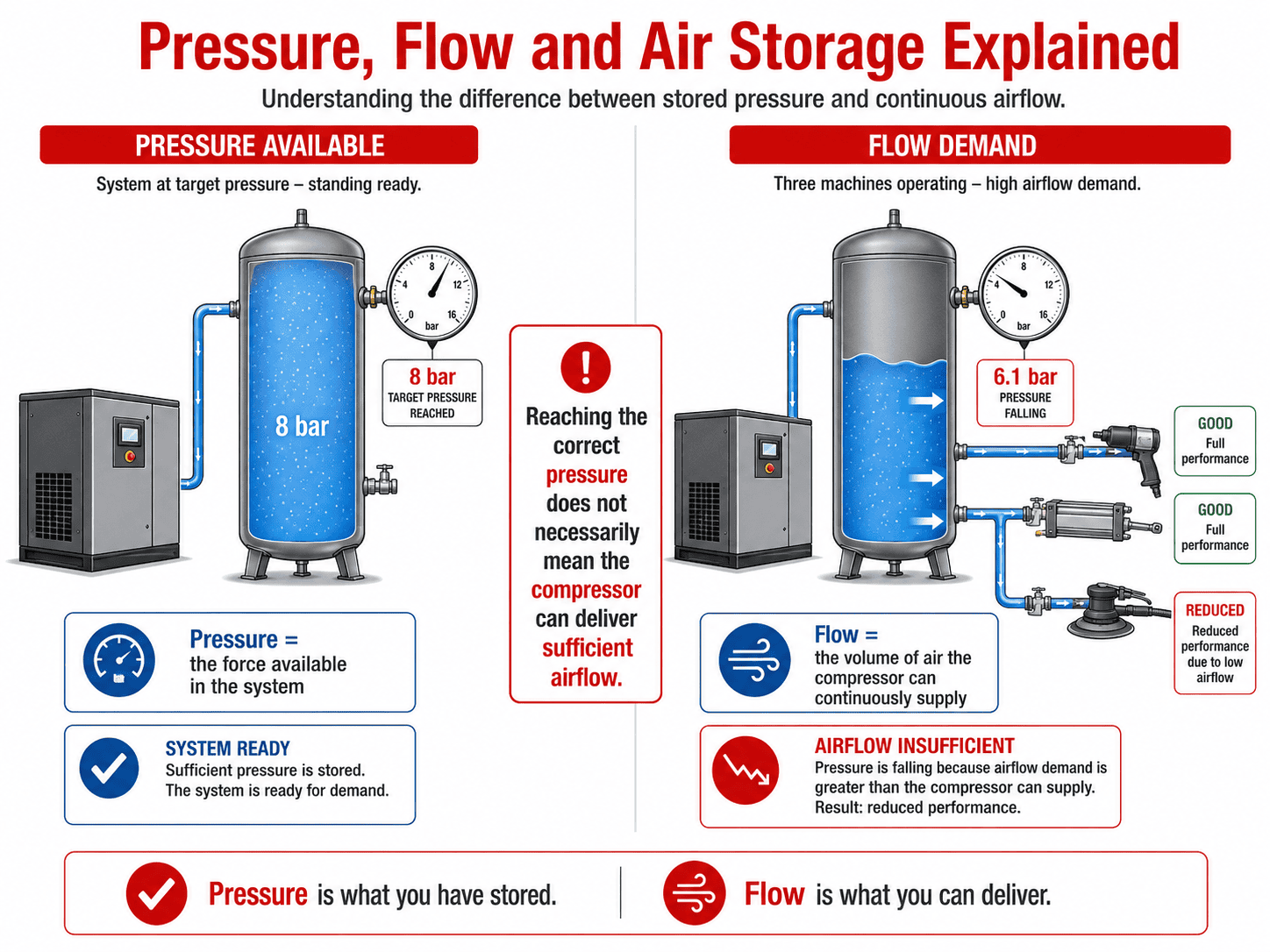
Pressure shows the force available, while flow determines whether enough compressed air can be supplied as equipment operates.
Step 9: Air Dryers Remove Water Vapour
A moisture separator removes liquid water, but the compressed air leaving the separator can still contain water vapour.
If that air cools further as it travels through the factory, additional moisture may condense inside the distribution pipework.
This can lead to:
- Internal pipe corrosion
- Damaged pneumatic equipment
- Contaminated products
- Frozen external air lines
- Poor paint finishes
- Unreliable instruments
- Increased maintenance
A compressed air dryer reduces the amount of water vapour remaining in the air. The correct dryer technology depends on the required pressure dew point, installation environment and sensitivity of the downstream process.
Refrigerated Air Dryers
A refrigerated dryer cools compressed air to a controlled temperature.
As the temperature falls, additional water vapour condenses into liquid. This liquid is separated and discharged before the compressed air is slightly reheated and returned to the system.
Refrigerated dryers are commonly used for:
- General manufacturing
- Workshops
- Indoor pneumatic equipment
- Packaging systems
- Standard production environments
They are normally suitable where an extremely low pressure dew point is not required.
Desiccant Air Dryers
A desiccant dryer passes compressed air through a material that attracts and retains water vapour.
Many industrial desiccant dryers use two towers:
- One tower dries the compressed air.
- The second tower regenerates the desiccant material.
The two towers then alternate between drying and regeneration.
Desiccant dryers can produce much lower pressure dew points than standard refrigerated dryers. They are commonly selected for:
- Instrument air
- Outdoor pipework exposed to freezing
- Sensitive manufacturing
- Laboratories
- Pharmaceutical processes
- Other demanding air-quality applications
Membrane Air Dryers
A membrane dryer uses bundles of permeable fibres.
Water vapour passes through the membrane material while the dried compressed air continues towards the outlet.
Membrane dryers can suit smaller or point-of-use installations, particularly where compact equipment and limited maintenance are important. However, purge-air consumption, inlet filtration and the required pressure dew point must be considered during selection.
The correct dryer and compressed air treatment should be selected according to the air quality genuinely required by the process. Specifying air that is much drier than necessary can increase equipment cost, pressure drop and energy consumption.
Drier is not automatically better
Compressed air should be dried to the level required by the application. Producing a much lower pressure dew point than the process needs may introduce unnecessary purge losses, pressure drop and operating cost.
Step 10: Filters Remove Remaining Contaminants
Compressed air filters remove contaminants that remain after cooling, separation and drying.
The correct filter arrangement depends on the contaminants present and the air-quality requirement at the point of use.
Different filter types are designed to remove different forms of contamination.
Particulate Filters
Particulate filters remove solid contaminants from the air stream, including:
- Dust
- Rust
- Pipe scale
- Desiccant particles
- Other solid debris
They may be installed before sensitive treatment equipment or downstream to protect pneumatic machinery and processes.
Coalescing Filters
Coalescing filters remove fine liquid aerosols, including:
- Water droplets
- Lubricant aerosol
- Other suspended liquids
The filter media causes very small droplets to combine into larger droplets. These collect within the filter housing and are then discharged through a drain.
Coalescing filters must be installed in the correct direction and maintained before excessive pressure differential develops across the element.
Activated-Carbon Filters
Activated-carbon filtration is used where oil vapour, odour or hydrocarbon contamination must be reduced beyond the capability of conventional coalescing filtration.
It is generally installed after suitable upstream particulate and coalescing filtration.
Not every compressed air installation requires activated-carbon treatment. Its use should be determined by the process risk and required air-purity class.
Why Filter Condition Matters
Every compressed air filter creates some resistance to airflow.
As the filter element becomes contaminated, the pressure difference between the inlet and outlet can increase. The compressor may then have to produce a higher upstream pressure to maintain the required pressure at the point of use.
Installing the finest possible filter throughout the entire factory is not necessarily efficient. Filtration should be matched to the local air-quality requirement and maintained according to element condition and manufacturer guidance.
Understanding Compressed Air Quality
Different industrial processes require different levels of compressed air purity.
A pneumatic tool may tolerate a different level of moisture, particles and oil from a pharmaceutical process, laboratory instrument, food-production line or sensitive control system.
ISO 8573-1 classifies compressed air purity according to:
- Solid particles
- Water
- Oil
The required purity class should be defined at the point where the air is used.
Treating the entire factory network to the most demanding requirement can create unnecessary pressure drop and operating cost. A site may instead use general treatment for the main distribution system and additional treatment close to sensitive equipment.
Treat Air According to the Point of Use
Depending on the facility, an efficient treatment strategy may include:
- General drying and filtration for the main factory network
- Additional point-of-use particulate or coalescing filtration
- A local desiccant dryer
- Activated-carbon treatment for a sensitive process
- A separate oil-free compressor
- Dedicated treatment for instrumentation or production equipment
Air treatment should protect the process without introducing more restriction, complexity or energy consumption than the application requires.
Match each treatment stage to the contaminant
Moisture separators remove bulk liquid, dryers reduce water vapour, particulate filters remove solids, coalescing filters remove liquid aerosols and activated carbon reduces vapour and odour.
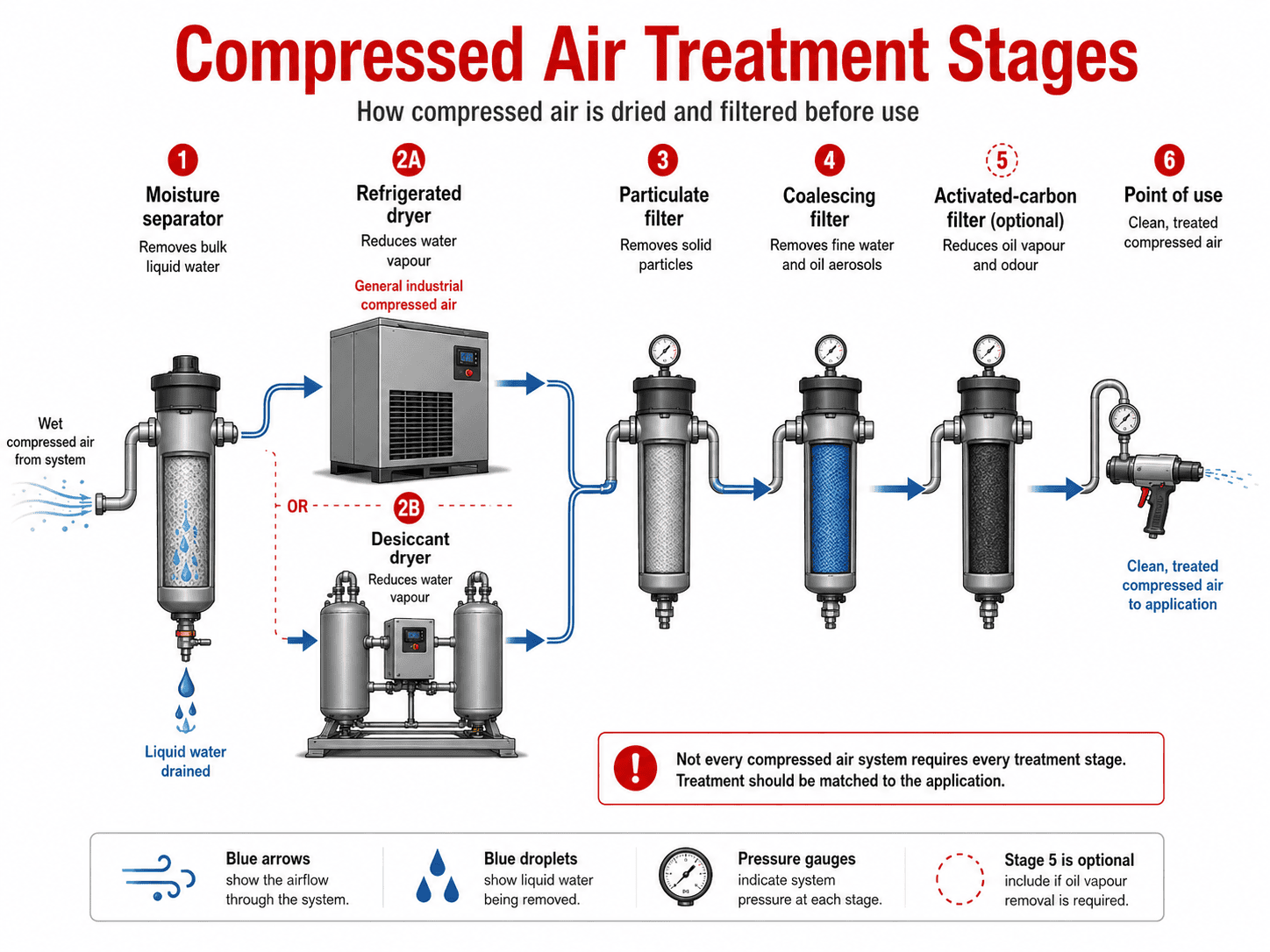
Compressed air treatment removes different contaminants in stages according to the air quality required by the application.
Step 11: Pipework Distributes the Air
The compressed air distribution system carries treated air from the compressor room to individual points of use.
A correctly designed network should deliver the required airflow while maintaining stable pressure throughout the system.
Poor distribution can make a correctly sized compressor appear unable to meet demand.
Common distribution problems include:
- Undersized main pipework
- Long or poorly planned pipe runs
- Excessive bends
- Restrictive fittings
- Blocked filters
- Small flexible hoses
- Poorly positioned take-offs
- Air leaks
- Inadequate condensate drainage
- No allowance for future expansion
Pressure drop normally becomes more severe as airflow increases. A system may therefore perform acceptably when demand is low but experience reduced pressure during peak production.
Before increasing the compressor pressure or purchasing additional capacity, the complete distribution system should be assessed.
Where Can Pressure Be Lost?
A pressure problem may be caused by:
- Undersized pipework
- A blocked filter
- A restrictive regulator
- A damaged or undersized hose
- A poorly selected quick-connect coupling
- An isolated high-demand machine
- Insufficient local air storage
Pressure readings should be taken at several points between the compressor and the equipment. This helps identify where the pressure is being lost rather than treating every low-pressure problem as a compressor-capacity issue.
Aroplus provides compressed air pipework installation for new systems, extensions and upgrades, with pipe sizing and layout considered as part of the wider compressed air requirement.
Measure pressure where the air is used
The pressure displayed at the compressor does not confirm the pressure available at the machine. Dryers, filters, pipework, regulators, hoses and fittings can all introduce losses between the compressor room and the point of use.
How Air Compressor Controls Work
Compressed air demand is rarely constant throughout the working day.
Demand may change because of:
- Shift patterns
- Production cycles
- Break periods
- Cleaning operations
- Intermittent machinery
- Several machines starting together
- Seasonal production changes
The compressor control system adjusts operation so that air production responds appropriately to demand while maintaining the required system pressure.
Start-Stop Control
With start-stop control, the compressor starts when system pressure falls to a lower set point and stops when the upper set point is reached.
This method is commonly used on smaller piston compressors and installations with intermittent demand.
If the air receiver is too small or demand changes frequently, the motor may start and stop too often. Excessive starting can increase electrical and mechanical stress.
Load-Unload Control
With load-unload control, the compressor motor continues running while the machine switches between producing compressed air and operating unloaded.
During loaded operation, the compressor supplies air to the system. During unloaded operation, it continues to run without delivering its normal output.
This avoids frequent motor starts, but an unloaded compressor still consumes electrical energy. Long periods of unloaded running can therefore reduce overall system efficiency.
Modulation Control
A modulating control system restricts the amount of air entering the compressor to reduce output.
This can help maintain relatively stable pressure, but efficiency may fall when the compressor operates well below its full output.
The motor continues running while the compressor produces a reduced quantity of air, so modulation should be assessed against the actual demand profile.
Variable-Speed Control
A variable-speed drive changes the speed of the compressor motor and air end.
As compressed air demand rises or falls, the compressor can adjust its output more closely to the required airflow.
Variable-speed control can be effective where demand changes substantially throughout the operating period. However, it is not automatically the best option for every installation.
A fixed-speed compressor operating close to full load may be more appropriate where demand remains stable.
Multi-Compressor Control
Sites with several compressors may use a central controller to determine which machines should:
- Start
- Stop
- Load
- Unload
- Change speed
- Operate as standby capacity
Correct sequencing can prevent several compressors from operating inefficiently at partial load.
A common arrangement uses one or more fixed-speed compressors to meet the stable base demand, with a variable-speed compressor responding to shorter fluctuations.
A compressed air audit can provide the demand data needed to determine whether the existing compressors and control strategy are correctly matched to the site.
Further guidance on compressor controls and system efficiency is available in the US Department of Energy’s Compressed Air Sourcebook.
Fixed-Speed Versus Variable-Speed Compressors
A fixed-speed compressor runs its motor at a set speed. Output is managed using methods such as start-stop, load-unload or modulation.
A variable-speed compressor changes motor speed to follow changes in compressed air demand more closely.
Neither arrangement is universally better. Selection should be based on how the site actually consumes air.
Fixed-Speed Compression May Suit
- Stable production demand
- Long periods operating close to full load
- Base-load compressor duties
- Sites with predictable operating patterns
- Installations where demand is largely constant across the shift
Control technology should follow the demand profile
Variable-speed technology can improve demand matching, but it should not be selected purely because it is newer or more adjustable. Compressor size, operating range, base demand, peak demand and the wider compressor sequence must all be considered.
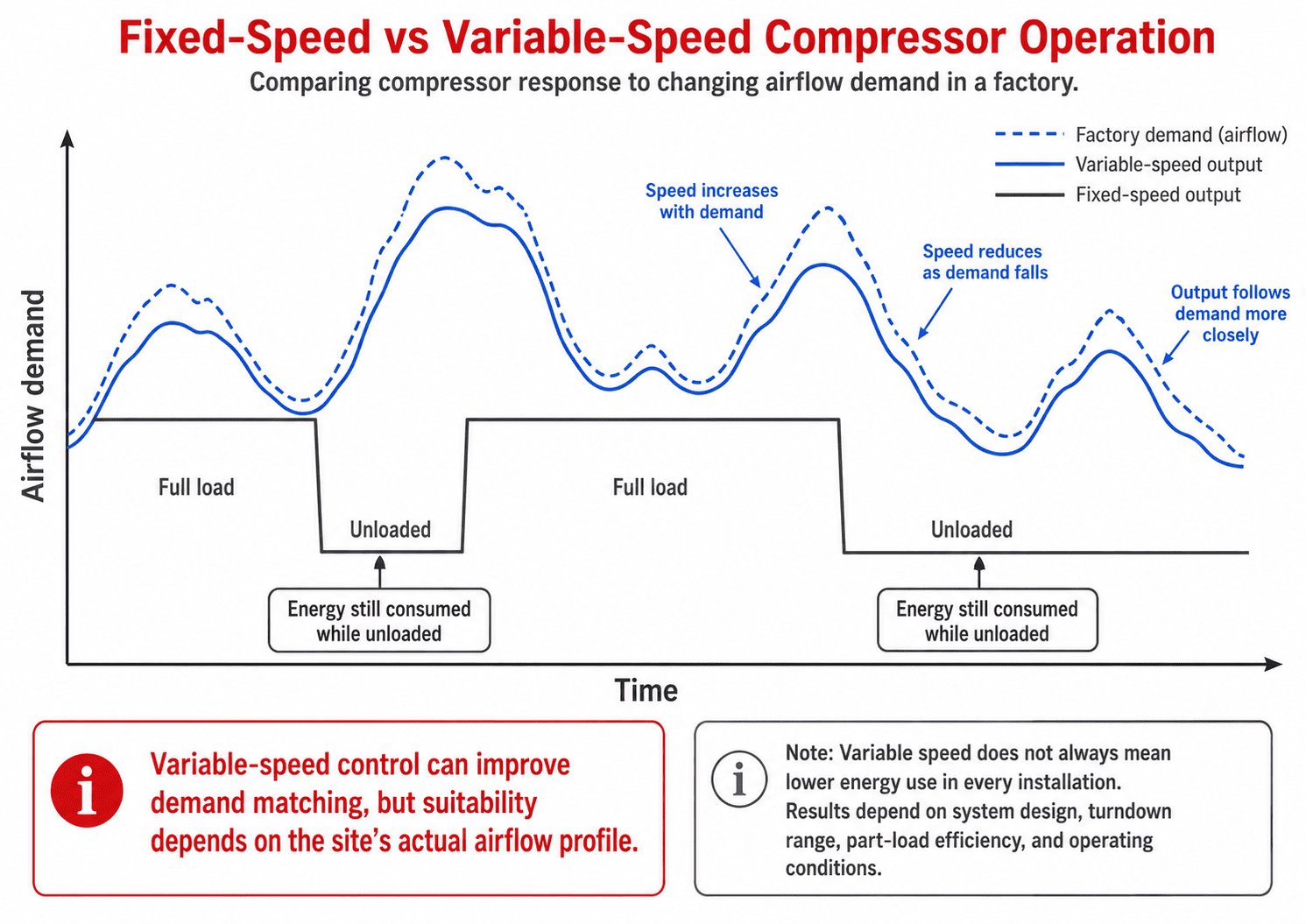
Fixed-speed and variable-speed compressors respond differently to changing compressed air demand.
How to Select the Correct Air Compressor
An air compressor should be selected as part of the complete compressed air system rather than as an isolated machine.
Compressor size alone does not determine whether a system will perform correctly. Pressure, airflow, demand variation, air treatment, storage, pipework and control strategy must all work together.
Selecting a compressor without understanding the application can result in:
- Insufficient airflow during production
- Excessive pressure and energy consumption
- Frequent starting or unloading
- Poor air quality
- Inadequate standby capacity
- Unnecessary capital cost
- Limited capacity for future expansion
The following information should be established before a new compressor is specified or an existing machine is replaced.
1. Required Working Pressure
Identify the minimum pressure required at the most demanding point of use.
The compressor must generate enough pressure to overcome legitimate losses through:
- The air dryer
- Compressed air filters
- Distribution pipework
- Regulators
- Valves
- Hoses
- Couplings and fittings
The compressor discharge pressure should not be increased unnecessarily to compensate for a blocked filter, restrictive fitting or undersized pipe.
Pressure should be measured at the equipment while it is operating, not only at the compressor.
2. Average and Peak Airflow
Both average and peak airflow must be considered.
Average airflow affects the compressor’s normal loading and overall operating efficiency.
Peak airflow affects:
- Pressure stability
- Receiver sizing
- Local air storage
- Compressor response
- Whether additional compressor capacity is required
A short-duration peak may sometimes be supported by correctly sized storage close to the demand. A sustained demand that exceeds compressor output requires sufficient continuous airflow capacity.
3. Duty Cycle and Operating Hours
Determine how often and for how long compressed air is required.
The demand may be:
- Occasional
- Intermittent
- Continuous
- Single-shift
- Multi-shift
- Twenty-four-hour operation
A piston air compressor may suit intermittent workshop or maintenance use, while a rotary screw air compressor is normally more appropriate for sustained industrial demand.
The compressor technology and control method should reflect the real operating pattern rather than simply the maximum possible demand.
4. Compressed Air Quality
Define the acceptable levels of:
- Solid particles
- Water
- Oil
- Vapour
- Other process contaminants
The compressor, dryer and filters should be selected as one treatment system.
General pneumatic equipment may only require standard refrigerated drying and filtration. Sensitive production, instrumentation, food, pharmaceutical or laboratory applications may require lower pressure dew points, additional filtration or oil-free compression.
Air should be treated to the standard required at the point of use without introducing unnecessary pressure drop or energy consumption.
5. Demand Variation
Review how the compressed air requirement changes throughout the working period.
Demand may vary during:
- Production start-up
- Shift changes
- Break periods
- Cleaning operations
- Batch processes
- Simultaneous machine operation
- Weekends
- Seasonal production peaks
A stable demand may favour fixed-speed base-load operation. A substantially changing demand may justify variable-speed control or a multi-compressor arrangement.
Demand should ideally be measured rather than estimated from compressor nameplates alone.
6. Installation Environment
The compressor room and surrounding environment affect performance, reliability and service access.
Consider:
- Ambient temperature
- Ventilation
- Dust and airborne contamination
- Humidity
- Available floor space
- Noise restrictions
- Electrical supply
- Drainage
- Access for maintenance
- Space for future equipment
The compressor should receive clean, cool intake air and have enough ventilation to remove the heat generated during operation.
Dryers, receivers and filters should also remain accessible for inspection and servicing.
7. Redundancy and Standby Capacity
Consider what happens if the main compressor is unavailable.
A process that cannot tolerate a loss of compressed air may require:
- Duty and standby compressors
- Multiple smaller compressors
- Automatic changeover
- Additional air storage
- Emergency connection points
- Temporary compressor provision
Two or more compressors can also provide greater flexibility when demand changes between shifts or production periods.
Standby capacity should be considered alongside servicing requirements, production risk and the cost of unplanned downtime.
8. Future Expansion
Allow for realistic future growth, including:
- Additional production equipment
- Longer operating hours
- New shifts
- Extra points of use
- Changes in required air quality
- Extensions to the distribution network
However, excessive oversizing should be avoided.
A compressor that is much larger than the current requirement may cycle frequently, spend excessive time unloaded or operate outside its efficient range.
Future demand can sometimes be accommodated more effectively through a modular compressor arrangement rather than one substantially oversized machine.
Do not select a compressor from pressure alone
A compressor may reach the required pressure while still being unable to provide sufficient airflow during production. Pressure, average demand, peak demand, storage and duty cycle must be assessed together.
Assess the Complete System
Compressor selection should account for the air treatment, receiver capacity, pipework and control system as well as the compressor itself.
Aroplus provides application-led support for selecting industrial air compressors and assessing complete compressed air requirements.
Where existing demand is unclear, a compressed air audit can provide measured information on pressure, airflow, compressor loading and demand variation.
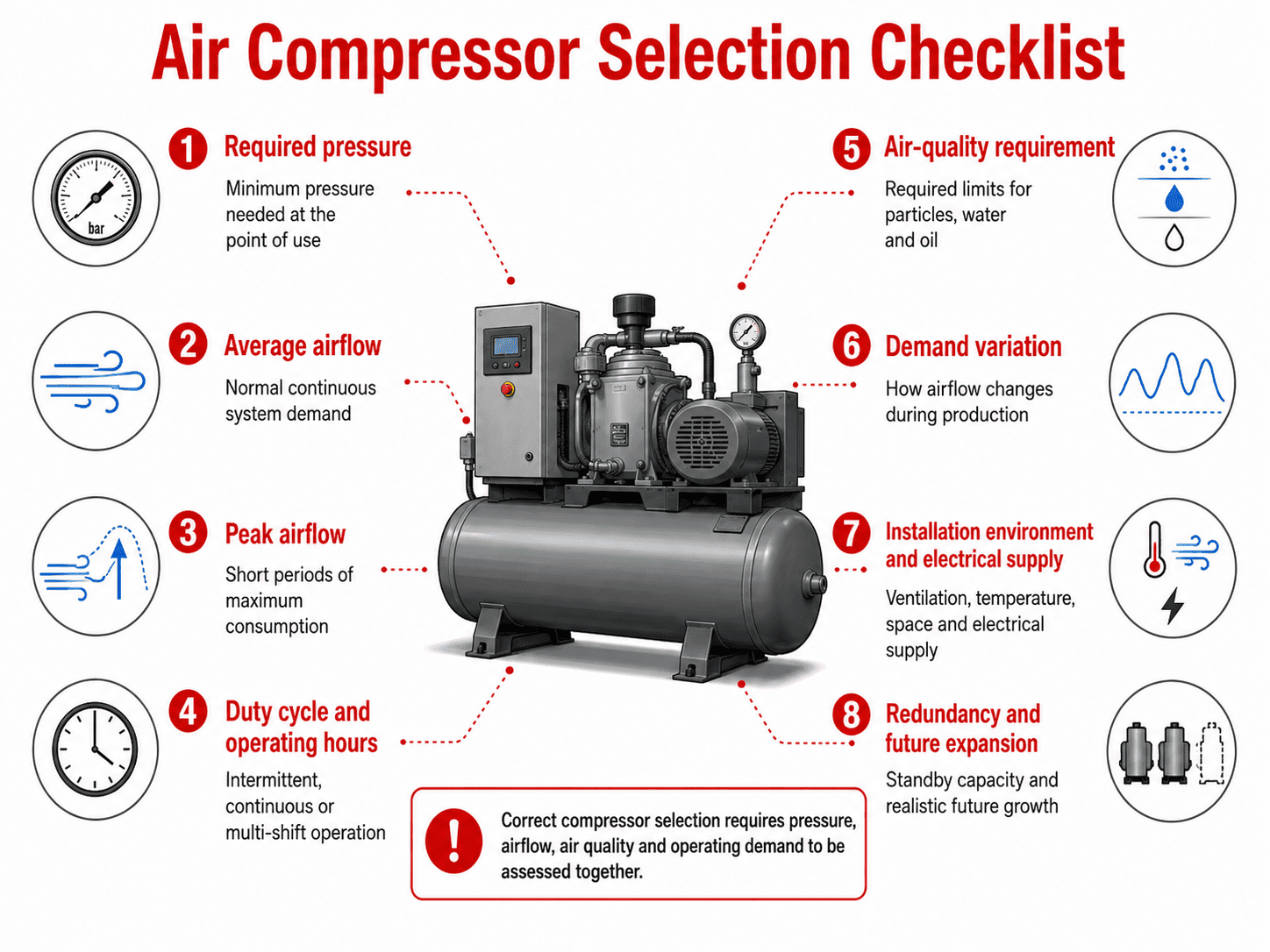
The key information required before selecting, replacing or resizing an industrial air compressor.
Where Compressed Air Energy Is Commonly Wasted
Compressed air is flexible and widely used, but producing it requires electrical energy. Inefficiencies can occur throughout the compressor station, treatment equipment, distribution network and point-of-use machinery.
A pressure or capacity problem should therefore be assessed across the complete system rather than automatically increasing the compressor pressure or installing a larger machine.
Common areas of compressed air waste include:
- Air leaks
- Excessive operating pressure
- Incorrect compressor sizing
- Poor compressor sequencing
- Restricted filters and separators
- Inappropriate compressed air use
- Poor maintenance
- Unused compression heat
1. Air Leaks
Compressed air leaks commonly develop at:
- Couplings
- Hoses
- Valves
- Condensate drains
- Pneumatic cylinders
- Filter housings
- Regulators
- Threaded pipe joints
A single leak may appear insignificant, but it can waste air whenever the system remains pressurised.
Leaks also create artificial demand. The compressors operate for longer or additional machines are brought online to replace air that never reaches productive equipment.
A structured leak-detection and repair programme can reduce compressor loading and may allow system pressure or operating hours to be reduced.
2. Excessive System Pressure
Some compressed air systems operate at a higher pressure to compensate for low pressure elsewhere.
This may temporarily mask a distribution problem, but higher pressure can increase:
- Compressor power consumption
- Air leakage
- Artificial demand
- Wear on pneumatic equipment
- Stress on hoses and fittings
Before increasing the pressure setting, check the dryer, filters, regulators, pipework, hoses and point-of-use fittings for avoidable restrictions.
The correct objective is to provide the required pressure at the equipment—not to maximise the pressure displayed at the compressor.
3. Incorrect Compressor Sizing
An oversized compressor may spend excessive time:
- Cycling
- Running unloaded
- Operating below its efficient range
- Starting and stopping unnecessarily
An undersized compressor may run continuously without maintaining the required pressure during production.
Correct sizing must consider average airflow, peak airflow, duty cycle, storage and demand variation. Selecting a compressor from pressure alone does not confirm that it can supply sufficient airflow.
4. Poor Compressor Sequencing
Sites with several compressors can waste energy when each machine responds independently to local pressure settings.
This may result in:
- Several compressors running partially loaded
- Multiple machines operating unloaded
- Compressors repeatedly loading and unloading against each other
- Excessive pressure variation
- Standby compressors running unnecessarily
A coordinated control strategy can assign compressors to base-load, trim and standby duties more effectively.
5. Restricted Filters and Separators
Filter elements, dryer components and air-oil separators create resistance as air passes through them.
As an element becomes contaminated, the pressure difference across it can increase. The compressor must then generate additional upstream pressure to maintain the required pressure downstream.
Pressure differential should be monitored and elements replaced according to their condition and manufacturer guidance.
Increasing the compressor pressure to overcome a blocked filter increases operating cost without correcting the restriction.
6. Inappropriate Uses of Compressed Air
Compressed air is sometimes used for:
- Open blowing
- Cooling
- Product drying
- General cleaning
- Continuous cabinet ventilation
In some applications, a blower, fan, vacuum system or electrically powered alternative may perform the task using less energy.
Compressed air use should be assessed according to the required pressure, airflow and process outcome rather than simply because an air connection is already available.
7. Poor Maintenance
Compressed air performance and efficiency can decline because of:
- Contaminated coolers
- Blocked intake filters
- Failed condensate drains
- Incorrect or degraded lubricant
- Worn drive belts
- Faulty controls
- Neglected dryers
- Restricted downstream filters
A compressor may continue running while gradually producing less usable air or consuming more electricity.
Planned maintenance helps preserve airflow, cooling, air quality and control performance rather than simply preventing complete machine failure.
8. Unused Compression Hear
A significant proportion of the electrical energy supplied to an air compressor ultimately becomes heat.
Where a suitable demand exists nearby, some of this heat may be recovered for:
- Space heating
- Workshop heating
- Process-water preheating
- Domestic hot-water preheating
- Other low-temperature applications
Heat recovery suitability depends on compressor type, operating hours, temperature requirement, ducting or water connections and the distance between the compressor and the heat demand.
Heat recovery should therefore be assessed as part of the installation rather than assumed to be practical in every compressor room.
Further technical guidance on compressed air efficiency and heat recovery is available in the Compressed Air Sourcebook.
Measure the system before changing the compressor
Low pressure or long compressor running hours may be caused by leaks, restrictions, poor control or distribution problems rather than insufficient compressor capacity. Measuring pressure, airflow and compressor loading helps identify the actual cause.
Identify Where the Air and Energy Are Going
Aroplus provides compressed air audits covering demand analysis, leak detection, compressor performance and distribution review.
An audit can help determine whether improvements should focus on:
- Leak repair
- Pressure reduction
- Control changes
- Filter replacement
- Pipework improvements
- Additional air storage
- Compressor resizing
- Heat recovery
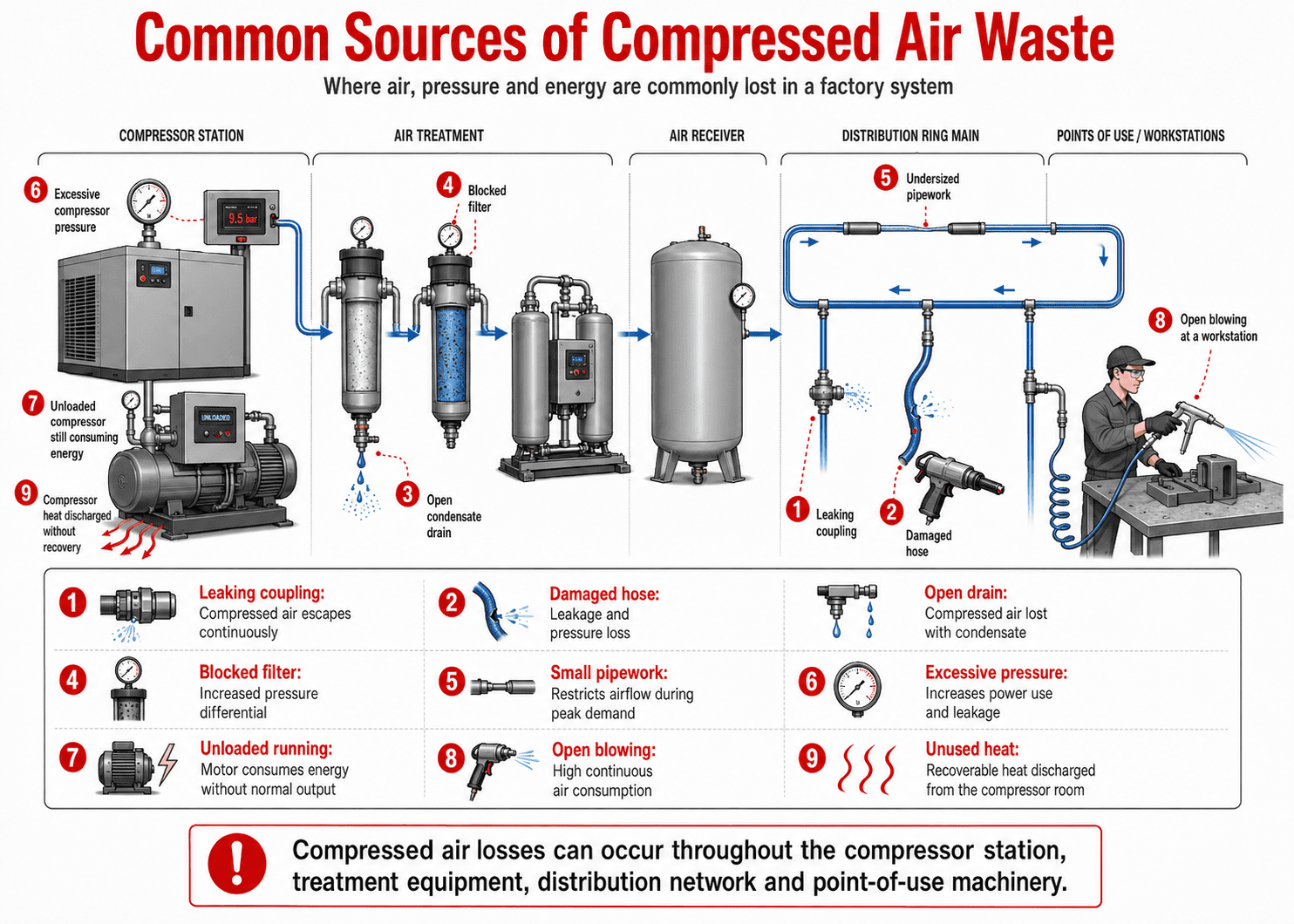
Compressed air losses can occur throughout the compressor station, treatment equipment, distribution network and point-of-use machinery.
Why Air Compressor Maintenance Matters
Air compressor maintenance affects more than whether the machine continues to run.
A poorly maintained compressor or treatment system may:
- Consume more electricity
- Run at a higher temperature
- Deliver less usable airflow
- Create additional pressure drop
- Carry moisture or oil downstream
- Cycle or unload incorrectly
- Experience premature component failure
- Reduce the reliability of production equipment
Maintenance should therefore consider the complete compressed air installation rather than only the compressor air end.
Typical Compressor Service Items
Depending on the compressor design, typical service items may include:
- Intake filters
- Compressor lubricant
- Lubricant filters
- Air-oil separator elements
- Drive belts
- Flexible couplings
- Cooling fans and heat exchangers
- Condensate drains
- Dryer operation
- Downstream filter elements
- Safety devices
- Sensors and control settings
The correct maintenance schedule depends on the compressor technology, manufacturer requirements, operating hours, load profile and installation environment.
Maintenance Intervals Should Reflect Operating Conditions
A compressor operating in a clean, temperature-controlled room may experience different service conditions from the same model installed in a dusty, hot or poorly ventilated environment.
Maintenance planning should consider:
- Total running hours
- Loaded and unloaded hours
- Number of motor starts
- Ambient temperature
- Dust and contamination
- Lubricant condition
- Pressure differential across filters
- Dryer and drain performance
- Changes in noise, temperature or vibration
Service work should follow the compressor manufacturer’s approved requirements and be completed by competent personnel.
Do Not Maintain the Compressor in Isolation
A compressor may be operating correctly while the overall system performs poorly.
Maintenance should also check:
- Air receivers
- Refrigerated or desiccant dryers
- Moisture separators
- Condensate drains
- Particulate and coalescing filters
- Regulators
- Distribution pipework
- Flexible hoses
- Point-of-use fittings
- Air leaks
A blocked downstream filter, failed drain or leaking pipe can increase compressor running hours even when the compressor itself is mechanically sound.
Planned maintenance protects system performance
Aroplus provides air compressor installation and service support, including planned maintenance, repairs, breakdown assistance and ongoing system support.
Compressed Air Safety
Compressed air is useful because it stores and transfers energy. That stored energy also creates hazards.
Potential risks include:
- Pressure-vessel failure
- Uncontrolled hose movement
- Air entering the body
- Skin penetration
- Eye injury from projected particles
- Hearing damage
- Unexpected movement of pneumatic machinery
- Hot-air discharge
- Contact with contaminated condensate
- Overpressurisation
Compressed air equipment should be installed, isolated, operated and maintained using appropriate procedures, safeguards and competent personnel.
Never Direct Compressed Air at a Person
Compressed air should not be directed at the body or used to clean clothing.
Even when the air pressure appears moderate, it can:
- Drive particles into the eyes or skin
- Cause hearing damage
- Penetrate damaged skin
- Propel loose debris at high speed
- Create uncontrolled hose movement
Safer cleaning methods should be identified through an appropriate risk assessment.
See the HSE’s Compressed Air Safety guidance for further information.
Isolate and Depressurise Before Maintenance
Before opening, disconnecting or maintaining compressed air equipment:
- Isolate the energy supply
- Prevent unintended restart
- Close the relevant air valves
- Release stored pressure safely
- Confirm that the component is depressurised
- Allow hot components to cool
- Follow the manufacturer’s instructions
Closing an isolation valve does not necessarily remove the compressed air trapped downstream. Receivers, hoses, filters and pipework can retain pressure after the compressor has stopped.
Inspect Hoses, Couplings and Restraints
Damaged hoses and incorrectly secured couplings can move violently if they separate while pressurised.
Check:
- Hose condition
- Coupling compatibility
- Correct engagement
- Thread and seal condition
- Hose restraints where required
- Signs of abrasion, cracking or heat damage
- Whether the hose is suitable for the operating pressure
Defective components should be removed from service rather than temporarily repaired for continued use.
Air Receivers and Pressure-System Requirements
An air receiver and associated compressed air equipment may form part of a pressure system containing significant stored energy.
Depending on the installation, duties may include:
- Establishing safe operating limits
- Providing suitable protective devices
- Maintaining the system correctly
- Preparing a written scheme of examination
- Arranging examinations by a competent person
- Keeping appropriate records
The exact requirements depend on the equipment and system arrangement, so site-specific competent advice should be obtained where necessary.
See the HSE’s Pressure Systems Safety Regulations guidance.
Compressed air is stored energy
A compressor being switched off does not mean every part of the system is safe to open. Receivers, filters, hoses and isolated pipe sections can remain pressurised until the stored air is released safely.
Frequently Asked Questions
These are some of the most common questions about compressor capacity, compressed air quality, pressure loss and control technology.
Does an air receiver increase compressor capacity?
No. An air receiver stores compressed air but does not produce additional airflow.
It can support short periods of peak demand, reduce rapid compressor cycling and help stabilise system pressure. However, the compressor must eventually replace all the air removed from the receiver.
If average demand remains greater than the compressor’s continuous output, receiver pressure will continue to fall.
Why does water collect in a compressed air system?
Atmospheric air naturally contains water vapour.
Compression raises the air temperature. When the compressed air subsequently passes through the aftercooler and becomes cooler, its ability to retain water vapour decreases. Some of the vapour then condenses into liquid water.
Moisture separators, drains and dryers are used to remove this liquid and reduce the remaining water vapour.
Is an oil-free compressor the same as filtered compressed air?
No. An oil-free compressor is designed so that lubricant is not introduced into the compression chamber.
An oil-injected compressor can use dryers and filters to produce highly treated downstream air, but that does not make the compression process oil-free.
The correct solution depends on the required air-purity class, the process risk and the consequences of contamination within the application.
Is a larger air compressor always better?
No. An oversized compressor may cycle excessively, spend long periods unloaded or operate outside its efficient range.
An undersized compressor may run continuously without maintaining the required airflow and pressure during production.
Compressor selection should consider average airflow, peak demand, duty cycle, air storage, air quality and future requirements—not pressure alone.
Why is the pressure lower at the machine than at the compressor?
Pressure is lost as compressed air passes through restrictions between the compressor room and the point of use.
Possible causes include:
- Undersized pipework
- Blocked filters
- Dryers
- Regulators
- Long or narrow hoses
- Restrictive couplings
- High airflow through a small pipe
- Air leaks
Pressure should be measured at several points while the equipment is operating. This helps identify where the loss occurs.
Correctly designed compressed air pipework helps reduce avoidable pressure loss between the compressor room and the point of use.
Does a variable-speed compressor always save energy?
No. Variable-speed control can improve demand matching where airflow changes substantially throughout the working period.
However, savings depend on:
- Compressor sizing
- Operating range
- Part-load efficiency
- Base demand
- Peak demand
- The wider compressor sequence
A correctly sized fixed-speed compressor may be more appropriate where demand remains stable and the machine operates close to full load.
How often should an air compressor be serviced?
Service intervals depend on the compressor type, manufacturer requirements, operating hours and installation environment.
Factors such as heat, dust, humidity, loaded hours and the number of motor starts can affect maintenance requirements.
The manufacturer’s approved service schedule should be followed, with filters, lubricant, separators, coolers, drains, dryers and safety devices checked as appropriate.
Aroplus provides air compressor service support for planned maintenance, repairs and breakdown requirements.
Can compressed air be used to clean clothing
No. Compressed air should not be directed at a person or used to clean clothing.
It can propel particles into the eyes or skin, cause hearing damage, penetrate damaged skin and create other serious injuries.
A safer cleaning method should be selected following an appropriate risk
Refer to the HSE’s Compressed Air Safety guidance for further information. assessment.
The Complete Compressed Air System Matters
An air compressor works by increasing the pressure of atmospheric air, but dependable compressed air requires much more than the compression mechanism.
The complete system must:
- Generate sufficient pressure
- Deliver the required airflow
- Remove compression heat
- Separate and discharge condensate
- Provide appropriate air storage
- Dry and filter the air
- Respond efficiently to changing demand
- Distribute air without excessive leakage or pressure loss
When these components are correctly selected and designed to operate together, a compressed air system can provide stable, clean and reliable power across a wide range of industrial applications.
Compressor sizing should therefore be approached as a system-level decision. The air end, motor, receiver, treatment equipment, controls and distribution network must all be matched to the application and its operating demand.
For a broader overview of compressor technologies, system equipment and support services, visit our industrial air compressors section.
Need Help Specifying an Air Compressor?
Speak to Aroplus about pressure, airflow, air quality, compressor controls and the wider system requirements for your application.
Assess an Existing Compressed Air System
If pressure, running hours or energy consumption have become a concern, measured demand data can help identify leaks, restrictions and control problems.